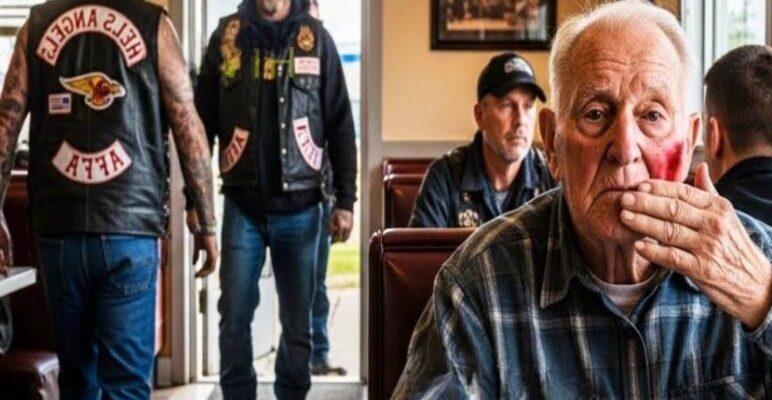
In a quiet diner, an elderly man sat alone, trembling yet filled with pride. Moments later, a thug’s hand struck his face, causing a hush to fall over the room—a silence that nobody dared to break.
While no one spoke, a dramatic turn occurred an hour later when the door swung open, shattering the stillness. His son entered in the company of the Hells Angels—welcome to a moment of dignity.
Before we delve into the tale, feel free to comment below regarding your location and consider subscribing to our channel. Each of your comments, gifts, and memberships supports us in sharing more impactful stories with you.
The sun had just begun its ascent over Ashefield, a small town where life moved at a slower pace than elsewhere. Inside a corner diner, Earl Whitman, at the age of 80, occupied his usual booth by the window.
Earl wasn’t just any old man; he was a veteran who had witnessed horrors unimaginable to most. While his hands trembled slightly as he lifted his coffee cup, the deep blue of his eyes retained a silent fortitude.
Familiar with him, the regulars offered nods of recognition, yet only a few truly understood his past. To many, he was simply the man who ordered black coffee and toast each morning.
However, beneath the weathered lines of his face lay memories of war, lost brothers, and sacrifices that no one in this diner could ever comprehend.
This morning felt mundanely familiar, saturated with the aroma of bacon and eggs, the chatter of waitresses, and the soft hum of an old jukebox—until the doorbell jingled, marking the entrance of a different energy.
The man entering did not fit the vibe of Ashfield’s diner. He was younger—around 35—with a leather jacket hanging carelessly over his shoulders, carrying an air of rage with each step.
His boots echoed sharply against the tiles, each stride seeming to provoke a challenge. Known as Trevor Cole, his name went unspoken, and no one dared to ask. He surveyed the room, a smirk plastered upon his face, dripping with arrogance.
Some patrons lowered their eyes, hoping to avoid drawing his attention. He radiated a tension that seemed to invite trouble. Unlike the rest, he did not sit quietly.
He crashed into a booth with a loud thud, bellowing for coffee and impatiently drumming his fist on the table. His voice was rough and piercing—commanding the room even in silence.
Earl noticed him but remained silent. Having lived long enough, he recognized storms as they brewed. Little did anyone realize that the tempest was closer than imagined—a storm poised to unleash directly upon Earl.
As Earl sat silently spreading butter on his toast with deliberate movements, Trevor continued to glare through the diner as though hunting for a target.
The waitress, anxious yet polite, tried to maintain her composure when serving him coffee. Trevor grimaced in disdain. “Is this all you can muster? Muddy water.”
His tone dripped with disdain. The patrons shifted uncomfortably in their seats, feigning disinterest, yet every ear strained to hear. Earl, who had always believed in respect—even towards strangers—spoke up just enough to be heard.
“Young man, there’s no need to address her in such a manner. She’s just doing her job.” The diner froze. Trevor slowly turned his head toward Earl, his smirk turning into something menacing.
“What did you just say, old man?” Earl did not flinch. His hands remained steady on the table. “I said: Be kind. It costs you nothing.” Silence enveloped the room for a moment, and then Trevor rose.
He approached Earl’s booth slowly, each step calculated as if savoring the rising tension in the space. Earl remained immobile, not even blinking. As Trevor reached the booth, he leaned in close, his voice oozing mockery.
“Kindness? What does a fossil like you know about kindness?” Without warning, his hand suddenly shot forward.
A sharp slap resonated through the air as Trevor’s palm connected with Earl’s cheek. The sound silenced everything—the clatter of dishes, the jukebox’s hum, even the anxious breaths of the waitress.
Earl’s face turned slightly from the force, yet his eyes never left Trevor’s. There was no anger, no fear—only a quiet, unwavering dignity. Trevor grinned with satisfaction.
“That’s what kindness gets you,” he sneered, standing up straight and challenging everyone in the diner with a glance. No one moved. No one spoke. The atmosphere thickened with shame and helplessness.
Earl gently dabbed the corner of his mouth with a napkin. His voice was soft but resolute: “You don’t understand what battles truly are, son.”
The diner stood in heavy silence. Trevor strutted back to his booth, proud of his display of power, while he sipped his coffee like a king on a throne, yet the guests couldn’t meet each other’s eyes. Embarrassment hung in the air.
Not just due to Trevor’s cruelty, but also because of their own silence. Earl sat there, toast untouched, his hand now trembling slightly. He did not cry. He did not shout.
He simply remained seated, shoulders poised, as if holding back memories that only he could bear. The waitress, with tears glistening in her eyes, whispered, “I’m so sorry, Mr. Whitman.” Earl offered her the faintest smile.
A smile that carried both forgiveness and sorrow. “Not your fault, dear.” Trevor laughed loudly, asserting his dominance over the atmosphere.
“You see, the old man knows his place.” He believed the moment belonged to him. What he failed to realize was that time had its own way of leveling the field.
Earl sat still, yet within him stirred memories like restless spirits. He remembered being eighteen, crouched in trenches far from home, mud in his boots, fear in his chest. He recalled brothers who never returned, men who had given everything for each other.
And he remembered why he had survived; someone had taught him that courage lay not in fists or volume, but in standing upright when the world tried to break you.
The slap meant nothing to Earl. His body was frail; pain was not a stranger. The silence in the diner cut deeper. The fact that everyone pretended nothing had happened.
That nobody defended dignity. He did not hate them. He understood. Fear is heavy. It silences the strongest voices. Even so, he whispered a silent prayer, not for himself, but for the stranger who bore so much darkness in his heart.
Trevor grinned across the room, convinced the war was over. Yet Earl knew battles often end differently than they begin.
In the back booth, a young man in his twenties shifted nervously. Pulling a baseball cap low over his eyes, he contemplated standing, to say something, but fear tethered him to his seat. He glanced at Earl, then back at Trevor, whose laughter filled the room. The waitress served another cup of coffee, her hands trembling so much that a drop spilled onto the counter.
She bit her lip, glanced at Earl, silently pleading for forgiveness. Earl caught her eye and nodded ever so slightly, as if to convey, “It’s alright.”
This nod sparked a fire in the young man’s chest. But before he could stand, Trevor slammed his hand on the table again. “No one has anything to say? Just as I thought.”
His grin widened, feeding on the silence. Outside, the distant rumble of a motorcycle engine could be heard, getting louder. Yet no one noticed it, but soon it would change everything in the diner. The time slowed within that space. Each tick of the old wall clock sounded louder, heavier—like a countdown.
Earl sipped his cooling coffee, tasting bitterness that grounded him. Trevor leaned back in his booth, arms spread wide like a king surveying his domain.
The guests shifted uncomfortably in their seats, their gazes darting toward the door, hoping someone would arrive—someone who could stand where they could not. Earl thought of his son, Caleb.
He had not seen him in weeks. Caleb worked long hours as a mechanic in the city. His life was rough around the edges but filled with loyalty and grit.
Earl had raised him to respect others and to fight only when necessary. Yet he also knew that Caleb harbored a fire within him—one that, once ignited, would be hard to extinguish.
Earl whispered his son’s name, more a prayer than a hope. Caleb was not there. Not yet. But outside, the distant thunder of the motorcycle approached.
A storm was heading toward the diner. Trevor, agitated, stood up again, gazing directly at Earl. “You know what your problem is, old man? You think respect means something. But respect is weakness.”
His words dripped with venom, and his grin dared anyone to oppose him. Earl met his gaze, his voice steady. “Respect is the only strength that endures.”
Trevor let out a sharp, cruel laugh. He eyed the diner, his gaze settling on the young man in the baseball cap. “And what about you, kid? Do you want to play hero? Stand and I’ll wipe the floor with you.”
The young man froze, shame flooding him. And Trevor grinned triumphantly. He turned back to Earl, towering over him. “You think you’re tough? Tell me, what does toughness look like now? Huh?”
Earl’s silence spoke volumes. It wasn’t weakness but defiance. Trevor leaned in closer, whispering, “You have no one left who fights for you.”
Just then, the roar of several motorcycle engines echoed outside. Trevor’s grin faltered slightly. The clock struck noon, and the storm arrived. The sound made the glass windows rattle.
Deep, rumbling engines vibrated the diner. Heads turned toward the door as it swung open. The atmosphere shifted immediately. Leather jackets, heavy boots, and the unmistakable aura of men who moved with unwavering authority filled the space.
In their midst stood Caleb Whitman, Earl’s son. Broad-shouldered, with remnants of oil beneath his nails. Caleb walked with the calm assurance of a man with nothing to prove.
Surrounding him were members of the Hells Angels. Their patches displayed boldly, their presence undeniable. The diner collectively held its breath, the silence thick with awe and fear.
Caleb’s eyes immediately found his father. He noticed the red mark on Earl’s cheek, his jaw tightening, and his hands flexing into fists. Without a word, Caleb crossed the room, each step echoing like a drumbeat.
Trevor leaned back—suddenly less assured. The balance of power flipped in an instant, and for the first time that morning, Trevor’s grin began to fade.
Caleb reached his father’s booth and knelt beside him. Initially, he said nothing. He simply gazed into Earl’s eyes. Earl’s calm gaze met the fierce fire in his son’s.
And in that silent exchange, more words were communicated than any speech could convey. Finally, Caleb broke the silence with his voice—a deep and rugged sound. “Who did this?” Earl, resolutely steadfast as ever, gently placed a hand on his son’s arm.
“It’s alright, Caleb. Let it go.” But Caleb’s gaze lifted, finding Trevor across the diner. The Hells Angels stood behind him like shadows, their presence filling every corner.
Trevor shifted restlessly in his seat, his arrogance now laced with unease. He attempted a grin, yet it trembled. Caleb rose, his voice laden with gravity.
“Stand up.” The room tensed. The young man in the baseball cap leaned forward, breaths held. Trevor’s hand twitched nervously on the table. The silence was now not filled with fear.
It was charged with expectation. Everyone awaited what would follow. Trevor hesitated. For the first time, he appeared smaller. But pride—that dangerous urge—pushed him to rise.
Slowly, he stood, trying to control his breath and hide his trembling hands. Caleb didn’t step closer. Not yet. His voice remained calm, almost too calm.
“Do you think it makes you strong to hit an old man?” Trevor let loose a sardonic laugh. “He deserved it.” Caleb’s eyes darkened. “That’s my father.” Those words struck harder than any blow.
The Hells Angels shifted slightly, their weight leaning forward, silently ready. The whole diner held its breath, as if even the clinking of a coffee cup could shatter the moment.
Trevor puffed out his chest, trying to reclaim the fading arrogance. “So what? You and your gang going to teach me a lesson?” Caleb slowly shook his head.
“I don’t need them to deal with you.” The diner froze. It was not about numbers. It was about truth. Earl’s hand gripped Caleb’s wrist, surprisingly strong.
“Son,” he said firmly, his voice slicing through the tension. “Don’t do it.” Caleb looked down, torn between anger and respect. Earl’s tone softened but carried the weight of many years.
“This isn’t your battle. This is his burden, not yours.” Caleb clenched his jaw, wrestling against the storm within. The Hells Angels observed quietly, bound by loyalty yet respecting the father’s words.
Trevor saw an opening and grinned again. “Exactly. Hide behind daddy’s wisdom.” But Earl’s gaze never wavered, sharp and unwavering.
“You confuse restraint with weakness. That is your greatest blindness.” Trevor’s grin faltered once more. The energy in the diner shifted—not through violence but through something far stronger: dignity.
Caleb exhaled, his fists unclenching, though his body still thrummed with unfulfilled fire. The young man with the baseball cap swallowed hard, realization washing over him—he wasn’t witnessing merely strength but a legacy—a passing on of a lesson from father to son.
The silence in the diner grew heavier, pressing against every wall. Trevor attempted laughter, but it now sounded hollow—like a man trying to convince himself.
Caleb stood unwavering, letting the quiet settle on Trevor’s shoulders. The waitress, her hands still trembling, finally spoke, her voice shaky.
“Why don’t you just leave?” Trevor spun sharply, glaring at her, yet the courage in her eyes held him at bay. One by one, other patrons lifted their gaze, no longer looking away.
The young man in the baseball cap stood straight. A couple in the corner, who had kept their heads bowed until now, nodded slowly. For the first time, Trevor faced not just a man or a gang.
He faced a room full of quiet resistance. Earl’s words had taken root. Respect surged like a tide. Trevor’s arrogance crumbled under the weight.
His fists clenched, but his confidence vanished. He no longer held control—and he knew it. Trevor’s breath quickened. He scanned the room desperately, searching for the authority he had possessed merely a few moments ago.
But now, every gaze bore into him—not out of fear, but out of judgment. His shoulders drooped slightly, even as he attempted to mask it with another grin.
Caleb took one step closer, closing the distance by a mere stride. Yet that step carried the weight of everything—the motorcycles outside, the Hells Angels behind him, and the blood of a man who had survived a war.
Trevor’s grin twitched. He tried to speak, but his throat tightened. “That… that doesn’t mean anything,” he mumbled, yet the words lacked power.
Then Earl spoke again, his voice calm yet commanding: “It means everything. It means that your fists do not rule here. But respect does.” Trevor looked at Earl. He truly looked—and not only recognized an old man but someone unbroken. Someone stronger than he could ever be.
For the first time, Trevor’s eyes dropped, and that was his defeat. The diner’s door felt further away than it really was. Yet eventually, Trevor moved toward it, his steps dragging—not sharp and commanding anymore.
The room remained still, observant. Every face that had turned away now looked him straight in the eye. The waitress stood tall, her shoulders squared.
The young man with the baseball cap removed it, finally revealing his eyes—firm and unwavering. Trevor’s boots scraped across the floor, his bravado evaporating.
He shoved the door open, the bell overhead ringing weakly. Outside awaited the roar of motorcycles. A wall of sound that reminded him of what he had lost. He didn’t look back.
He couldn’t. The diner exhaled like a single body, the heavy air finally lifting. Earl took a sip of his cold coffee, finally placing the cup down.
Caleb sat across from him, his fists still tense, but his eyes softened as he looked at his father. Respect had been defended—not through violence but through dignity. And that lesson endured.
Caleb leaned forward, his voice quiet and breaking: “I should have…” Earl gently interrupted him. “No, son. You did exactly what was needed. You stood your ground.
And sometimes standing your ground doesn’t mean striking. Sometimes it means holding back.” Caleb’s jaw quivered. He had always believed strength meant action. Yet, as he looked at his father—weathered yet unbroken—he understood something deeper.
The Hells Angels, known for their toughness, stood silently, their respect for Earl etched into their gazes. Even they recognized the power of restraint.
Caleb nodded slowly, his chest lightening, the fire within him transforming into something steadier. “I get it now,” he whispered. Earl smiled faintly. “Good. Because the world doesn’t need more fists. It needs more hearts.”
The young man in the baseball cap finally stood, approached Earl’s booth, and softly said, “Thank you, sir.” His voice trembled, yet contained courage. Earl nodded.
Courage is contagious—and now it had filled the whole diner. Gradually, the diner came back to life. Conversations began once again, hesitantly at first, then warmer.
The jukebox hummed to life, filling the quiet with gentle music. Dishes clattered, coffee was poured, and the air felt lighter—almost sacred. The waitress placed a fresh cup of coffee in front of Earl, her hands steady now.
“On the house,” she said with a smile. Earl thanked her, cautiously lifted the cup, and savored its warmth. Caleb leaned back, looking at his father with new eyes.
Not just as a parent, but as a man who bore an unbreakable truth. The Hells Angels silently filled the booths around them, their laughter soft yet respectful—like guardians who had now come to rest.
The young man with the baseball cap sat up straighter, confidence glowing within him like a new flame. The diner had transformed; it was no longer merely a spot for breakfast.
It had become a place where silence was shattered, dignity remained firm, and a lesson was planted within every soul. As the afternoon sun streamed through the windows, Earl turned to his son.
“Caleb,” he said softly, “a man’s true strength is not measured by how hard he hits. It’s measured by what he protects.”
Caleb swallowed, the words sinking deep within him. He gazed at his father, the red mark still faint on his cheek, feeling both pride and sorrow. Pride that his father had stood firm.
Sorrow for the cruel world that often mistreated men who bore such dignity. Earl reached across the table, wrapping his weathered hand around Caleb’s firmly.
“Promise me something, son. When the world pushes you, don’t merely push back. Stand taller. That way, you’ll honor me.” Caleb’s eyes misted over, yet he nodded firmly. “I promise, Dad.”
The jukebox played a gentle melody, almost as a hymn. Outside, the motorcycles rumbled again, ready to depart. Inside, an old soldier bestowed the final truth of his battles.
As Earl finally stood, the diner rose with him—not out of obligation but out of respect. He politely tipped his hat to the waitress, smiled at the young man in the baseball cap, and patted his son on the shoulder. Together, they walked toward the door. The Hells Angels followed Caleb like silent sentinels.
As they stepped outside, sunlight poured over the diner floor, brighter than before. The guests remained seated in silence—not out of fear, but in contemplation. They had witnessed something rare.
Not fist against fist but dignity against arrogance. Outside, Earl lifted his face to the breeze. The roar of motorcycles around him surged like a hymn.
He closed his eyes and whispered words that no one else could hear: “Respect always prevails.” Caleb looked at his father—not as a fragile old man but as the strongest man he had ever known.
The road lay ahead of them, endless and alive, and together they walked into the light. In a world that often mistakes power for cruelty, Earl reminded us all that true strength lies in respect.