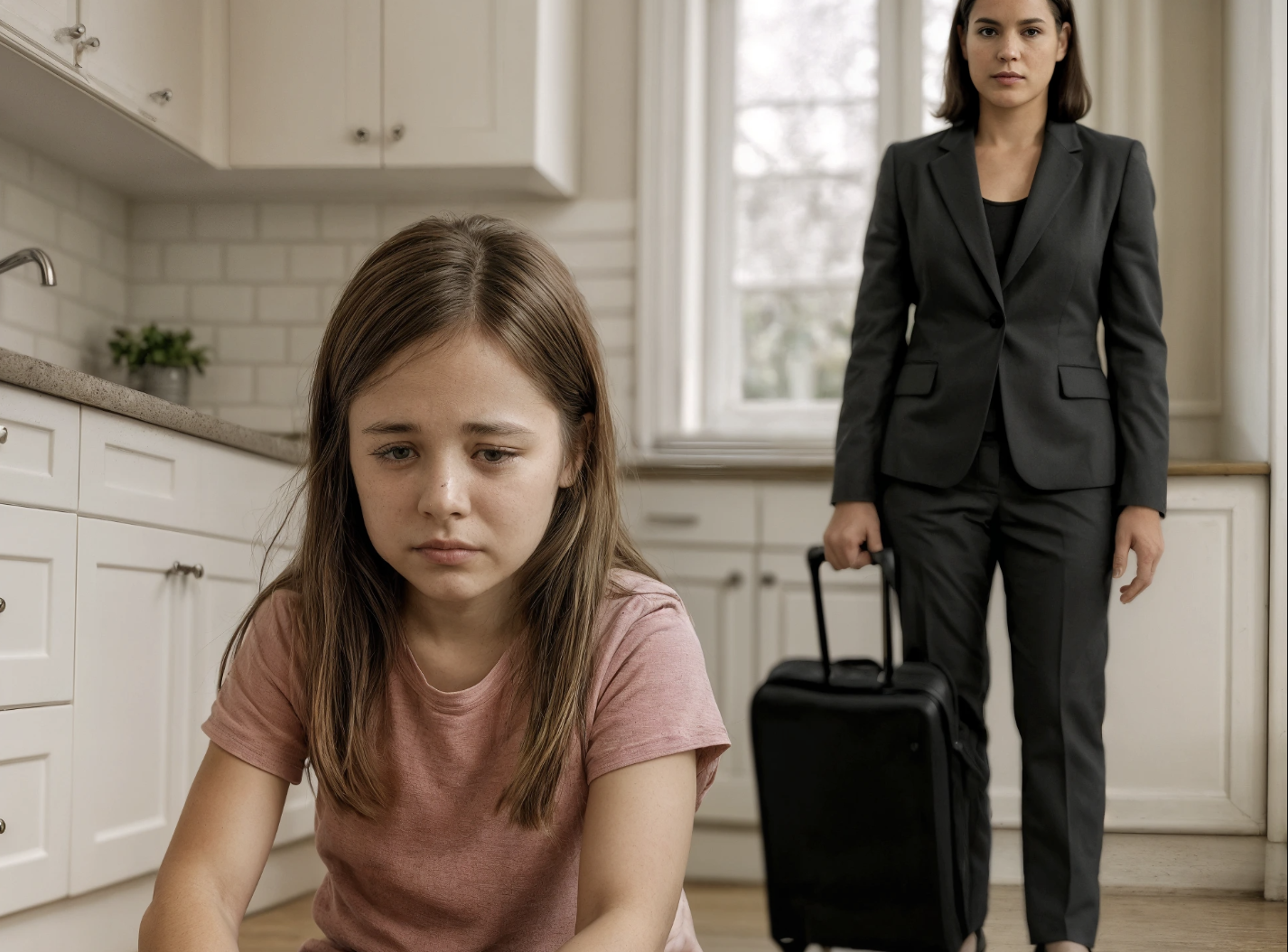
We found refuge in a modest motel tucked along the road, about an hour from our destination, somewhere on Highway 75. The place was typical, with a flickering neon sign and the smell of stale coffee, but it wasn’t just clean—it was, above all, peaceful.
Lily fell asleep quickly, nestled against me, one arm resting on her soft stuffed animal.
I, on the other hand, stayed awake, staring at the worn ceiling, listening to the hum of the old air conditioner.
By morning, my phone was a nightmare: ten missed calls from my mother-in-law, five from my husband, and several unknown numbers, probably relatives wanting to “mediate.”
Finally, I opened a message from Mark, my husband:
Where are you? Mom is hysterical. She says you kidnapped Lily.
The word “kidnapped” tightened my chest. I started to type a reply but deleted it.
Instead, I sent a photo: Lily, peacefully asleep, safe, no words attached.
By noon, Mark had found us. His face showed fatigue, confusion, and a hint of anger.
We met in the motel parking lot, under the scorching Texas sun.
“Karen,” he began, rubbing the back of his neck, “Mom says you left without warning. She’s…”
“Your mother left our daughter unsupervised. For hours. While they were at the amusement park.”
He blinked, perplexed.
“That’s not possible.”
“She saw it. Ask Lily.”
Mark lowered his eyes, visibly troubled.
“They say it was just a short moment…”
“Seven hours, Mark.” My voice cracked slightly. “Seven hours. Barely nine years old.”
He took a deep breath, as if trying to absorb the shock.
“I’ll talk to them.”
“I already did,” I replied. “Last night.”
My husband furrowed his brow.
“What did you do?”
I looked him straight in the eyes.
“I went to their house. I collected all the toys and gifts meant for Lily and left them on their doorstep, with a note.”
His jaw tightened.
“Karen…”
“The note said: ‘You cannot choose which grandchild deserves your love.’”
He stared at me intently, murmuring,
“They’ll never forgive you.”
“I’m not looking for forgiveness,” I replied. “I want respect—for my daughter.”
We stood there for a while, both exhausted, realizing this wasn’t just a simple quarrel, but years of bias, hurtful jokes, and excuses made to preserve a so-called “family harmony.”
That evening, once we returned home, I told Lily she no longer had to visit her grandparents if she didn’t want to.
She gave a small smile and asked if we could order pizza.
I nodded.
As we watched cartoons on the couch, my phone vibrated again—a message from Mark’s mother:
You’ve destroyed this family.
I set the phone down, screen facing the table.
“No,” I whispered. “I finally protected her.”
Three weeks passed before we saw them again.
It was at Emily’s birthday—Mark insisted we go “just for an hour, a minimum to stay civil.”
The moment we walked through the door, tension was palpable.
His parents stood by the cake table, surrounded by relatives, pretending nothing had happened.
At the sight of Lily, conversations stopped, glances were exchanged, and someone quickly changed the subject.
My mother-in-law, Susan, approached with a fragile smile.
“Karen,” she said sharply, “you’ve caused quite a scandal.”
“I only told the truth,” I replied.
“You’ve gone too far,” she hissed. “We left her with the neighbor. She wasn’t alone.”
“Strange,” I noted, “because the neighbor knew nothing.”
Susan’s face turned red.
“You turned Mark against his own family.”
I looked at Mark, frozen by my side.
“If telling the truth is ‘poisoning,’ then this family has been sick for a long time.”
A heavy silence fell over the room.
Susan opened her mouth, but Mark intervened calmly.
“Mom, enough. You can participate in Lily’s life as long as you treat her like your granddaughter. Otherwise, you won’t be part of it.”
Susan stared at him in shock until anger took over.
“So, you would choose her family over ours?”
He looked at me, then glanced at Lily clutching her rabbit tightly.
“I choose what’s right.”
The rest of the party passed in a blur.
We stayed just long enough for Lily to have a slice of cake, then left without a word.
In the car, she gazed out the window at the passing scenery.
“Mom,” she said softly, “I don’t think I want to see them anymore.”
I held her hand gently.
“You don’t have to go, sweetheart. Not if you don’t want to.”
That night, as I tucked her in, she asked:
“Are we still a family?”
A smile formed on my lips.
“We always are. We’ve just stopped letting harmful people decide for us.”
Outside, the city buzzed—cars, a train in the distance. Ordinary sounds, but to me, they symbolized freedom.
The next morning, an unexpected calm enveloped our home.
And for once, that silence was comforting.
For the first time in years, our home had finally regained its essence.