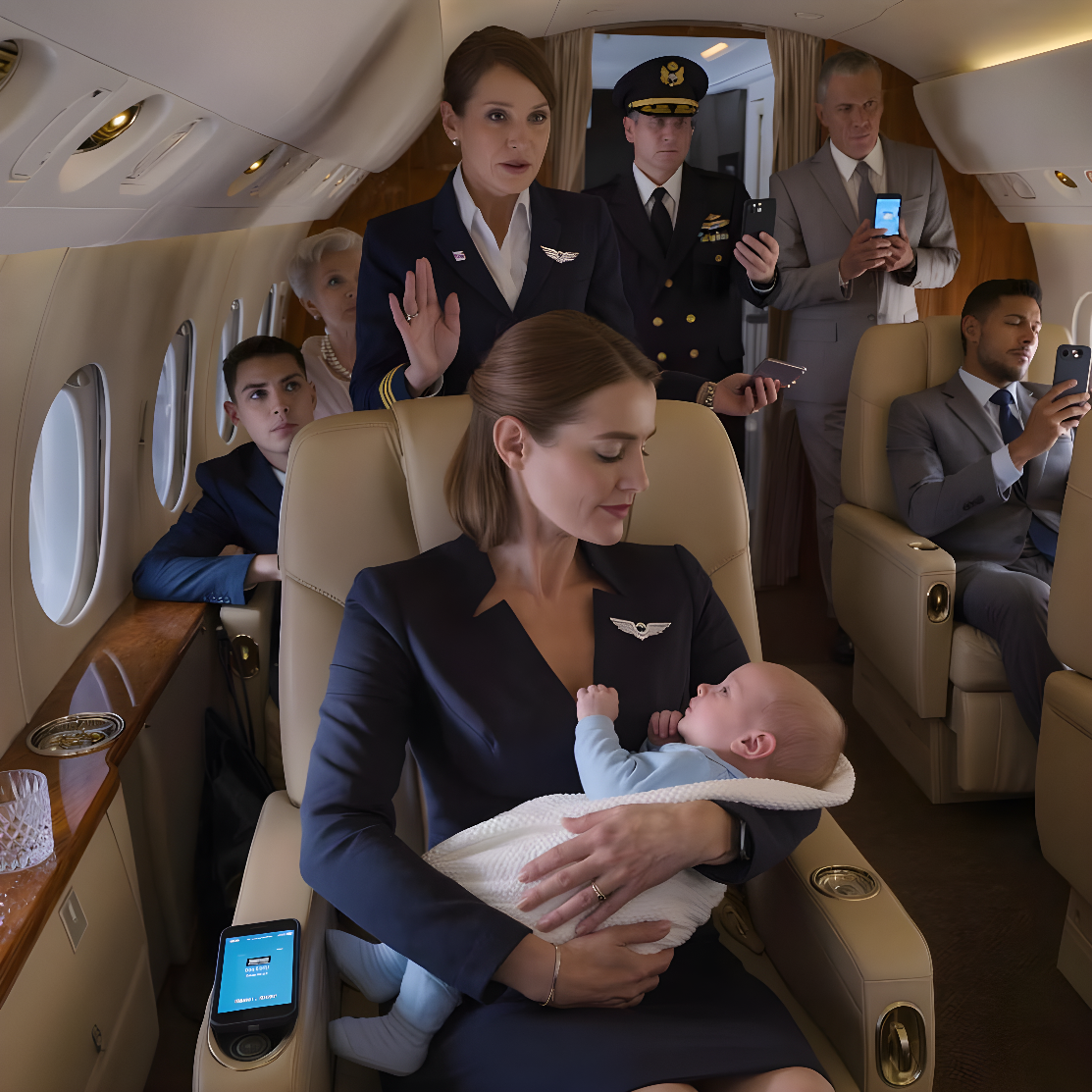
The atmosphere in the cabin was undeniably tense as silence fell—it was as if time had paused. A chime signaling the need to fasten seatbelts rang out, its sound light and almost trivial, yet filled with unspoken weight.
“If you cannot manage your child, I will be forced to call security and have you both removed from this flight at once,” a voice pierced through the tension.
A sharp smack resonated through the first-class section, where Sandra Mitchell, the flight attendant, had just slapped Kesha Thompson’s cheek. Kesha held her six-month-old daughter, Zoe, who began to cry out loudly from the shock. Nearby, passengers instinctively raised their phones to capture what many believed to be a necessary intervention against a disruptive traveler.
“At last, someone stands up for the rest of us,” murmured an older lady adorned in pearls.
Kesha winced, feeling the sting on her cheek yet maintaining her composure. With trembling hands, she adjusted Zoe’s blanket while her boarding pass—listing her as Mrs. K. Thompson with an overlooked special status—lay upon her lap. The cabin turned quiet except for Zoe’s muffled whimpering and the clicks of recording cell phones.
“Have you ever encountered public judgment as a ‘bad parent’ before anyone even asks if you require assistance?”
With a self-assured demeanor, Mitchell straightened her navy uniform, the silver wings on her lapel shimmering as she played to an audience that seemed captivated. The fresh vigor from her previous actions had given her a moment to display authority to the premium passengers.
“Ladies and gentlemen, I apologize for this inconvenience,” Mitchell’s voice resonated deliberately loud everywhere in the cabin. “Some individuals simply fail to grasp proper travel etiquette.”
Applauding whispers traversed the cabin. A businessman dressed in a sharp suit nodded in Kesha’s direction. “It’s about time someone maintained decorum.”
Kesha remained mute, gently rocking her baby to soothe the upset cries. Zoe’s small hand formed a tight grip around her mother’s finger—an image that should have elicited compassion from the onlookers but just seemed to annoy them further.
“I’m connecting with the captain,” Mitchell said confidently as she picked up her radio. “Captain Williams, we have a level-three disturbance in first class—a disruptive passenger with an infant, who is not adhering to crew directives.”
The radio crackled in response. “Acknowledged, Sandra. What are your next steps?”
“I suggest we proceed with removal before we depart; the delay is already at eight minutes.”
Glancing at her phone, Kesha noted that they had just fourteen minutes remaining until takeoff. A text notification caught her eye—a reminder of a corporate merger announcement scheduled for 2 PM ET. She quickly stowed her phone away from Mitchell’s view.
“Pardon me,” Kesha interjected quietly, her voice barely rising above the noise of the cabin. “My boarding pass indicates seat 2A. I paid for first-class service, and I would appreciate—”
“Oh please,” Mitchell interrupted with a sarcastic laugh. “Madam, I couldn’t care less about the circumstances that earned you that ticket. People try to upgrade improperly all the time. I recognize every tactic.”
Across the aisle, a young passenger was livestreaming. “You guys, this is unbelievable. A flight attendant just hit a mother with a baby. I’m in shock,” she exclaimed. The viewer count skyrocketed as fast comments fluctuated—many judgmental, others expressing concern.
Noticing the filming, Mitchell leaned further into her role. “If you cannot control your child adequately, I have the authority to request your removal. Our airline’s policy is unequivocal concerning disruptive passengers.”
Kesha rummaged through her carry-on for formula. A platinum card caught her eye, glistening in the light—it was an executive card tucked among baby supplies. She quickly repositioned it. The card was distinctly different from a conventional frequent flyer card.
As her phone buzzed again, she noticed the caller ID read: SkyLink Airways Executive Office. She declined the call, knowing eyes were upon her.
Mitchell’s demeanor shifted. “And whom did you think you were calling? No one overrides federal regulations from the ground.”
The insult struck hard. Passengers around the cabin chuckled lightly, sensing the escalating tension.
The businessman commented, “Miss, you’re delaying 180 passengers with this melodrama. Many of us have significant business matters to address.”
“We have ten minutes remaining until mandatory departure,” Captain Williams’s voice broke in through the intercom. “Flight crew, prepare for final boarding checks.”
Kesha glanced at her wristwatch—a modest black timepiece bearing an inscription on the back: To my wonderful wife, M.T.
“Ma’am, I’m asking you for the last time,” Mitchell spoke firmly. “Please gather your belongings and deplane willingly. Should you refuse, federal air marshals will escort you off.”
The livestream soared to eight thousand spectators. The stream of commentary flooded in faster than the person filming could comment. Amid harsh critiques were several distinct voices: Something’s off here. Why is the mother so composed? The attendant seems overly aggressive.
A passenger seated by the window began typing on a professional forum, quickly titled: Witnessing Discrimination Live: SkyLink Flight 847. In no time, industry insiders had caught on.
Mitchell pressed her radio once more. “Captain, the passenger remains uncooperative. Requesting immediate ground security.”
“Acknowledged. Security team is on standby.”
Kesha spoke again, her voice steady despite feeling embarrassed. “Ma’am, I understand that you believe you are following regulations. However, I strongly urge you to verify my passenger status before taking an action that cannot be undone.”
“Irreversible?” Mitchell’s voice shot up at the provocation. “The only irreparable thing is your conduct.”
The elderly woman in pearls leaned forward and said, “In my time, parents knew how to manage travel with children. What I see here is simply disgraceful.”
More phones raised high. Facebook Live. Instagram stories. The hashtag #FlightDrama began trending locally.
Kesha remained composed despite the chaos—no shouting, no arguing, no demands. Her collected demeanor instilled discomfort, like someone well-aware of something that the others were not. The baby calmed, feeling the soothing rhythm of her mother’s heartbeat. Little Zoe gazed around, her innocent curiosity taking in the entire cabin.
“We have ten minutes to go,” Mitchell emphasized. T–10. Kesha mentally resolved, Don’t feed them the narrative they seek; provide them with a truth they cannot alter. “Security will arrive in ten.”
Kesha kissed Zoe’s forehead softly, whispering something inaudible to the surrounding chaos. Her gaze held a depth of understanding that seemed to make some nearby uncomfortable; a moment of anticipation hung in the air.
Captain Derek Williams approached the first-class area, his gold stripes catching the cabin lights. With over two decades in aviation, he had learned the art of exuding absolute authority in such conflicts.
<p“What’s unfolding here, Sandra?” His tone demanded attention.
<p“Captain, this passenger has been disruptive since boarding—crying child, contentious about instructions, and resisting deplaning.”
He scrutinized Kesha, taking note of her youth, designer diaper bag, and first-class ticket, unconsciously siding with Mitchell’s version of events.
<p“Ma’am, I’m Captain Williams. You must adhere to the crew’s directives, as per federal regulations.”
The livestream crossed over the fifteen-thousand mark. “The captain has arrived,” the college student informed her viewers. “This is escalating.” People began commenting: She’s about to get arrested. The captain appears furious. Bye, lady—deserve the no-fly list.
Kesha adjusted Zoe, her phone discreetly showing she had eight minutes until the cut-off.
<p“What about the eight minutes?” Williams pressed. “Whatever timetable you think you’re adhering to does not supersede safety measures.”
Two plainclothes federal air marshals emerged from the galley, recognizable to astute observers. Tension escalated as the situation shifted from a service issue to a potential security threat.
Air Marshal Rodriguez approached with caution, his hand near his concealed weapon. “Captain, what’s the nature of this disturbance?”
<p“Passenger defiance,” Williams replied. “Refusal to deplane following crew assessment.”
The blogger paused to take pictures for his post. His content was resonating—hundreds of comments piled in.
Mitchell activated the intercom. “Ladies and gentlemen, we apologize for the delay caused by this uncooperative passenger. We hope to rectify the situation soon.”
Frustrations arose. “Just remove her.” “I have a connection to catch.” “This is absurd.”
The views on the livestream swelled to twenty-five thousand. Local news systems began pinging alerts: A viral occurrence is underway aboard SkyLink flight.
Kesha persisted in her seat. Zoe had settled down, intrigued by her surroundings. Her calmness felt almost eerie—as if she was anticipating something significant.
Air Marshal Johnson came up next to her. “Ma’am, please gather your belongings and follow us willingly.”
<p“I only need five more minutes,” Kesha replied softly. T–5. Kesha reminded herself: Count the beats, not the faces. We’re prepared for storms larger than this.
<p“You require zero minutes,” Williams retorted sharply. “This is a federal vessel under my command, and you create a safety risk.”
The older woman raised her chin, making her voice loud for the cameras. “Captain, I have been flying for sixty years. This kind of entitled behavior is precisely what is wrong with air travel today.”
The narrative had crystallized: the disruptive mother versus the professional crew. But the social media commentator noticed details that didn’t align—no signs of genuine distress, merely evidence of control. He typed vigorously: The passenger is too serene. Something unusual is occurring.
Kesha’s phone buzzed relentlessly; the caller ID highlighted yet again: Skylink Emergency Corporate Line. She hit decline.
Mitchell’s gaze sharpened. “Who keeps calling you? No one can bypass federal aviation law remotely.”
Laughs rippled from the crowd. The businessman raised his phone higher to capture Mitchell’s display of authority.
<p“Six minutes left,” Williams announced, glancing at his watch. T–6. Captain thinks: Keep the timeline under control. Don’t lose the cabin. Don’t let the narrative slip. “Ground security is currently boarding.” Outside, security vehicles gathered, sirens flashing. The series of events had escalated beyond a mere removal; the livestream surged to thirty-two thousand. Screenshots circulated widely on social media platforms.
As the ground security personnel entered through the front galley—fully equipped with radios and cameras—their presence marked the escalation to a forcible removal.
“Ma’am,” the lead officer proclaimed, “by directive of the captain and federal air marshals, you are to be removed from the aircraft. Please comply.”
Kesha scanned the cabin—phones recording, animosity in people’s stares, overpowering authority. Zoe trilled softly, reaching out towards the gleaming badge.
<p“Four minutes left,” Kesha said calmly. T–4. Kesha told herself: Almost there, Zoe. Almost to safety.
<p“You have zero minutes,” Williams reiterated. “Officers, escort this passenger and her child off this plane right away.”
Security advanced. Phones leaned closer, eager to capture the moment. The livestream ticked to thirty-eight thousand viewers.
Something in Kesha’s eyes caused even the most attentive occupants to hesitate. She displayed no panic nor desperation; she was simply waiting.
Air Marshal Rodriguez hesitated. “Ma’am, if you possess legitimate documentation, now is the moment to disclose it—”
<p“Rodriguez,” Williams interjected, “we do not engage in negotiations with rebellious passengers. Remove her this instant.”
Mitchell stepped forward confidently. “This is the reason for our protocols. Some individuals believe they can manipulate situations for social media applause.”
Cheers erupted for Mitchell’s assertiveness. Viewers commended the crew’s perceived “professionalism.”
Kesha kissed Zoe on the forehead and whispered something soft beneath the din. Then she deliberately lifted her phone.
<p“Three minutes,” she announced, pressing a singular contact. T–3. Chen narrates: My messages are blowing up—should I post now or hold? Hold. Let the moment finish first. She activated speaker mode.
<p“Hi, darling,” she spoke in gentle tones. “I’m encountering difficulties on your airline.”
The voice on the other end halted Captain Williams in his tracks. “Which flight, sweetheart? I will handle this directly.”
Every SkyLink captain recognized that voice. It belonged to the individual who signed their paychecks.
<p“Flight 847, located in first class,” Kesha stated steadily. “The crew is.. creatively interpreting customer service.”
Seething fury emanated from the phone. “I’m Marcus Thompson, CEO of SkyLink Airways. Every individual on that aircraft will retract immediately from my wife.”
An immediate hush fell, interrupted only by Zoe’s playful coos and the muted hum of ground vehicles. Mitchell’s face lost its color. Williams staggered back a half-step.
The livestream exploded to over forty-five thousand viewers. Comments erupted: Plot twist. She’s the CEO’s spouse. Career-threatening moment.
Air marshals stepped back, the atmosphere seemingly shifting around Kesha.
<p“Captain Williams. Ms. Mitchell,” Marcus’s voice was as cold as ice, “your actions are being reviewed under my orders, and this does mean personally.”
Kesha remained collected, rocking Zoe gently as one hundred-and-eighty pairs of eyes fixated on her.
<p“Two minutes until takeoff, love,” she added lightly. T–2. Captain thinks: This is heading downhill. Authority is a taut rope; you sense it go before you visualize the departure.
<p“Cancel departure,” Marcus instructed. “We have more significant issues to tackle.”
The woman they had tried to evict was married to the family that operated the airline, and everyone on board had been witnesses to it all, live.
<p“And is both you and Zoe safe?” Marcus inquired.
<p“We are alright now,” Kesha responded. “Though Ms. Mitchell did strike me while I was holding my baby.”
Her admission sent shockwaves through the cabin. Passengers were realizing their recordings had documented what could become a serious assault on the CEO’s spouse.
<p“A misunderstanding?” Marcus questioned, cutting him off. “Captain, I’m observing the live feed. Hundreds of thousands just witnessed my wife being struck by your personnel.”
The stream surged to forty-seven thousand. The college student filming could scarcely stabilize her phone.
<p“Ms. Mitchell,” Marcus responded, his tone unyielding, “you just labeled my spouse as ‘just a passenger’ after striking her. I’m officially recording this dialogue for legal purposes.”
The blogger’s headline rocketed to two thousand shares among industry leaders. Breaking—SkyLink team strikes CEO’s spouse on a live broadcast.
Air Marshal Rodriguez raised his hands slightly, taking a step away. “Mrs. Thompson, we were responding based on crew reports. We held no awareness of your identity.”
<p“Of course not,” Kesha stated gently while adjusting Zoe’s blanket. “That was precisely the problem—how passengers are treated when assumptions take precedence over verification.”
Williams attempted a shift. “Sir, let’s address this matter discreetly—”
<p“Captain,” Marcus interrupted, sarcasm laced in his voice, “the time for privacy closed when your team went public with this.”
The woman in pearls sank back slowly into her seat, her earlier approval of “standards” recorded in live streams.
Kesha unveiled the platinum card she had hidden before—not a frequent flyer card but a card confirming ownership: Mrs. Marcus Thompson — First Family, embossed in gold. She raised it for the nearest camera.
Collective gasps echoed. Several passengers lowered their phones, aware their opinions now tied to their identities.
<p“Darling,” Kesha spoke into the phone, “should I bring up the merger announcement?”
<p“Not at this moment,” Marcus replied with a calm demeanor. “Let’s observe how they navigate the next five minutes.”
<p“Should you?” Kesha queried softly. “Have you ever come across photos? Does the airline provide our personal details to staff?”
The response was clear: confidentiality protocols are established for executive families.
Ground responded with confusion. “Flight 847, please clarify your status. We note security responses in effect.”
<p“Ground, I’m Marcus Thompson. Cancellation of all security responses to 847 is in order. I will oversee it personally.”
“Received, Mr. Thompson. Forces are standing down.”
The stream soared to fifty-two thousand viewers. Local news stations rushed toward the airport. The hashtag #SkyLinkScandal gained nationwide traction.
Kesha began a video call. The screen unveiled a conference room filled with executives scrutinizing the cabin live.
<p“Ladies and gentlemen,” she addressed those present, “meet SkyLink’s leadership team.”
The camera glided across corporate officers, legal advisors, and a federal aviation liaison—expressions revealing shock, anger, and readiness for crisis. Marcus emerged, wearing a suit that resonated authority, his eyes ablaze with determination.
<p“Ms. Mitchell,” he spoke loudly for all to hear, “you just laid your hands on my spouse in front of more than fifty-four thousand witnesses. Federal laws classify assault aboard an aircraft as a matter of grave concern.”
<pMitchell’s knees buckled under her; her voice trembled. “Mr. Thompson, I—I was ignorant. I followed safety instructions.”
<p“Safety instructions?” Marcus raised an eyebrow. “Demonstrate to me the regulation permitting crew members to strike a passenger with an infant.”
Such a regulation did not exist.
The businessman who had earlier supported Mitchell pursued attempts to erase his posts. Screenshots of them spread rapidly.
<p“Captain,” Marcus interrupted, “this matter has escalated; it’s now with the FAA and DOJ. ‘Internal’ channels are wholly insufficient.” He gestured off-camera. “Legal, status?”
Head attorney David Park stepped forth. “Our team is preparing charges under federal assault laws, civil rights protections, and considerations for child endangerment.”
Kesha’s voice echoed through first class. “Marcus, should I allude to the cabin security recordings?”
Skylink’s lead attorney joined the video call. “Mrs. Thompson, as per federal regulations, onboard incidents necessitate documentation. We possess multiple recordings.”
A collective understanding permeated the room: not only had many watched live online—there was high-definition cockpit-approved recordings available.
<p“Captain Williams,” Marcus asserted, “through your two-decade career, how many discrimination complaints have been filed under your oversight?”
<p“I do,” Marcus asserted. “Seventeen complaints over five years—settled quietly without acknowledgment. That practice ends today.”
The crowd absorbed the information. Skylink had been shielding discrimination, today’s public assault unveiled those hidden truths.
<p“Standard for what?” Marcus pressed. “For a mother flying with an infant who remained calm and respectful, who neither shouted nor resisted?”
No answers came forth.
<p“Flight 847 will not depart,” Marcus confirmed, “until each passenger exits and this aircraft is secured for federal review. Ms. Mitchell and Captain Williams—you are suspended immediately while we pursue action.”
<p“You made a conscious choice,” Kesha stated softly. “Every decision warrants repercussions. Today those repercussions are transparent.”
<p“Ladies and gentlemen,” Marcus said, addressing both the cabin and viewers online, “you bore witness to what persistently occurs in aviation: decisions forming based on faulty assumptions. Today was different—everyone observed, recorded, and will remember.”
<p“The merger can wait, honey,” Marcus said to Kesha with warmth. “We must address more urgent matters at hand.”
<p“Prior to individual consequences,” Marcus stated, “we must establish the facts. Last year, SkyLink generated $4.2 billion in revenue. Customer satisfaction metrics stood at ninety-one percent. Today’s occurrence jeopardizes operational licenses, insurance coverage, and federal contracts—close to eight hundred million annually.”
<p“Legal,” Marcus commanded, “please share Captain Williams’s history with complaints against his crew.”
<p“Ms. Mitchell,” Marcus continued, “your employment history reveals prior incidents and mandated training you chose to neglect.”
<p“Those were separate occurrences,” she protested, her voice straining. “This passenger was genuinely disruptive—”
<p“Was she?” Kesha asked quietly. “Marcus, would you like us to air the cabin audio?”
<p“Legal,” Marcus prompted.
- “Control your child, or—”
- The instant slap.
- “Some individuals don’t know how to travel correctly.”
- “People like you often try to upgrade illicitly. I catch every trick.”
- “Your partner won’t save you from aviation laws.”
Each statement merged into a damning revelation. Viewers of the livestream fell silent as the evidence accumulated.
<p“I concur,” Marcus replied. “Our team has isolated charges relating to assault, civil rights infringements, and endangerment with an infant present.”
<p“Understood,” Marcus clarified, toning down his voice for law enforcement accuracy. “Protocols demand independent verification prior to escalation. We will organize additional training.”
<p“Counsel,” he added, “what is our potential liability if this escalates to federal litigation under comprehensive coverage?”
<pSimultaneously, the business blogger’s updates saw thousands of retweets each minute. “SkyLink CEO’s spouse struck by crew live on stream. Federal investigation underway. Stock sunk by eight percent post-market.”
<p“Everyone,” Marcus announced over the PA system, “you’re witnessing corporate accountability unfold in real-time. Ms. Mitchell and Captain Williams—your employment is terminated immediately.”
<p“Please cite the federal guideline that permits a crew member to strike a passenger carrying an infant,” Kesha interjected calmly.
<p“Legal,” Marcus continued, “outline the immediate repercussions.”
<p“Ms. Mitchell faces federal assault allegations,” Park stated. “Captain Williams will contend charges relating to facilitation and failures regarding passenger safety.”
<p“Furthermore,” Marcus emphasized, “under our zero-tolerance policy for discrimination, both individuals are forfeit of benefits subject to applicable regulation. Certification reviews from the FAA will commence within seventy-two hours.”
<p“Sir,” Williams attempted once more, “I’ve dedicated twenty-two years—”
<p“Twenty-two years which reflect a pattern of enabling,” Marcus stated bluntly. “Passenger rights have been violated repeatedly during your command.”
<p“That’s already in progress,” Marcus replied. “Effective immediately, SkyLink is advancing a Family Protection Protocol. Any unauthorized physical interaction without direct safety justification results in immediate termination and referral. Mandatory training will encompass forty hours—focusing on bias-awareness, advanced de-escalation techniques, and outlining federal passenger rights. Failing to meet completion standards will incite certification forfeiture.”
The magnitude of reform initiated was unprecedently expansive.
<p“Ms. Mitchell,” Marcus stated resolvedly, “you’ll be escorted by federal authorities for processing according to law. Your actions were observed by over seventy thousand viewers and documented by aircraft systems.”
<p“Captain Williams, your termination is immediate. Investigators will scrutinize flights completed under your supervision.”
<p“Legal,” Marcus instructed, “announce the Passenger Bill of Rights.”
<p“Excellent inquiry,” Marcus affirmed, “Marshals will undertake training to differentiate between crew-initiated bias and legitimate security worries.”
<p“Mr. Thompson,” the investigator wound down, “your compelling response surpasses federal demands. The DOT will view this as exemplary.”
<p“Understood,” Marcus concurred. “Our corporate jet will be ready in thirty minutes.”
<p“I misjudged you,” he confessed, his voice thick with emotion. “If you allow it—I’m sorry.”
The woman in pearls focused on her hands. “My granddaughter is Zoe’s age,” she whispered. “I lost sight of what assistance looks like.” She retrieved a travel pack of wipes from her purse, extending it forward with both hands as an offering. Kesha acknowledged the gesture with a nod—an act of kindness barely captured by the cameras.
<p“Today uncovered systemic imperfections we shall no longer overlook. SkyLink will set the benchmark for passenger dignity and crew responsibility.”
The Family Protection Protocol initiated across networks within twenty-four hours. New signage manifested in every aircraft: Every family has a rightful place here. Respect first. Verification always. Training commenced instantaneously. Within a windowless classroom near Concourse C, a seasoned instructor sketched a small box on a whiteboard and penned inside it: VERIFY. Underneath, in smaller print: BREATHE. LISTEN. HELP. A fresh staff member raised their hand. “What if passengers are filming everything?” The instructor capped the marker. “Proceed under the assumption they do. Engage in the conduct you’d hope to have recorded.” Partnerships forged with civil rights groups for bias-awareness programming. Lack of completion within thirty days triggered automatic termination.
A Passenger Bill of Rights gained legislative sponsorship within months and emerged as federal law—mandating public reporting of discrimination claims and compulsory training across U.S. carriers. Industry publications branded it the Thompson Standards.
Mitchell’s trial commenced three months later. Evidence was undeniable—varied angles, recorded audio, and tens of thousands of witnesses. Williams faced separate action for his facilitation and negligence. Their professional trajectories came to an end, reputations obliterated.
SkyLink’s stock dipped momentarily, then recuperated within a week as investors recognized the company’s firm and transparent responses. Rivals rushed to emulate similar protocols. Business travelers—especially families—favored the airline that exemplified responsibility. Revenue surged. Satisfaction levels among diverse travelers set unprecedented records. Air marshals Rodriguez and Johnson underwent enhanced training and turned advocates for real-time bias recognition.
The business writer’s contemporary coverage gained a national journalism nomination. His records became essential reading in crisis management programs in business schools.
Most significantly, cultural change emerged. “Individuals like you” vanished from vernacular. Crew members relocated their starters to, “How may I assist your family’s travel experience?” Chen used her platform to initiate a civil rights documentary series. Her inaugural film, “35,000 Feet: Dignity in the Sky,” accrued accolades and propelled further reformation.
Global airlines willingly adopted the Thompson Standards. In Memphis, new hires rehearsed de-escalation scenarios utilizing compromise gates and audio of distressed infants. In Seattle, a captain paused a briefing to say, “Begin every call with ‘How may I assist?’ You will be astonished at what it resolves.” A global shift in aviation culture towards passenger respect took root. The incident involving Mitchell became a permanent cautionary lesson in crew training. Williams’s downfall taught that authority without ethical bravery served no one.
The aircraft where the event unfolded was retrofitted with advanced recording and compliance mechanisms, earning the distinction of SkyLink’s flagship for passenger safety.
Zoe grew up, frequently traveling with her parents. Crews competed among themselves to provide exemplary service to the family whose calm resilience revolutionized an industry. Tales poured in—families safeguarded, assumptions scrutinized, dignity acknowledged.
Two years later, the incident involving SkyLink became a Harvard case study in accountability. Kesha Thompson’s tranquil handling of pressure became essential viewing in conflict resolution training sessions. Her narrative illustrated how authority grounded in principle can provoke institutional change.
Kesha’s acceptance speech at a national civil rights gala was succinct: “Dignity ought not be contingent upon wealth or status. Today it isn’t—because all have observed the visage of accountability.” That evening, an email appeared from an unrecognized address. Subject line: I Owe You More Than ‘Apologies.’ It was from Derek Williams. No extenuating circumstances—only details related to the principles he previously disregarded, moments when he opted for silence. He concluded, “Even if you don’t respond, I will devote the remainder of my career to repairing what I contributed to shattering.” Kesha starred the correspondence and then gently rocked Zoe to sleep.
Global standards unfurled. Seventeen countries embraced family safety protocols. Allegations of discrimination reported among principal carriers plummeted significantly. Openness became the normalized approach.
Most crucially, families boarding flights no longer readied themselves for confrontations. Children witnessed their parents’ dignity safeguarded as a matter of policy. The takeaway? Assumptions bear costs, while accountability fosters genuine progress.
Zoe laughed frequently aboard airplanes. The child whose cries previously prompted waves of prejudice now traveled within a culture reshaped by her mother’s unwavering poise.
Have you ever experienced discrimination during your travels? Share your story. If you too have been a spectator who remained silent, recount that experience—the next moment you might be the one who speaks up. If you recognize yourself in the quiet observer, share that tale too—so that when the time comes, you are vocal. United voices enact system changes—and preserve their integrity. On the jet bridge, as Kesha stepped into the bright terminal with Zoe on her shoulder, a line of ground crew paused and one of them raised two fingers in a subtle salute. Finally, the room exhaled.