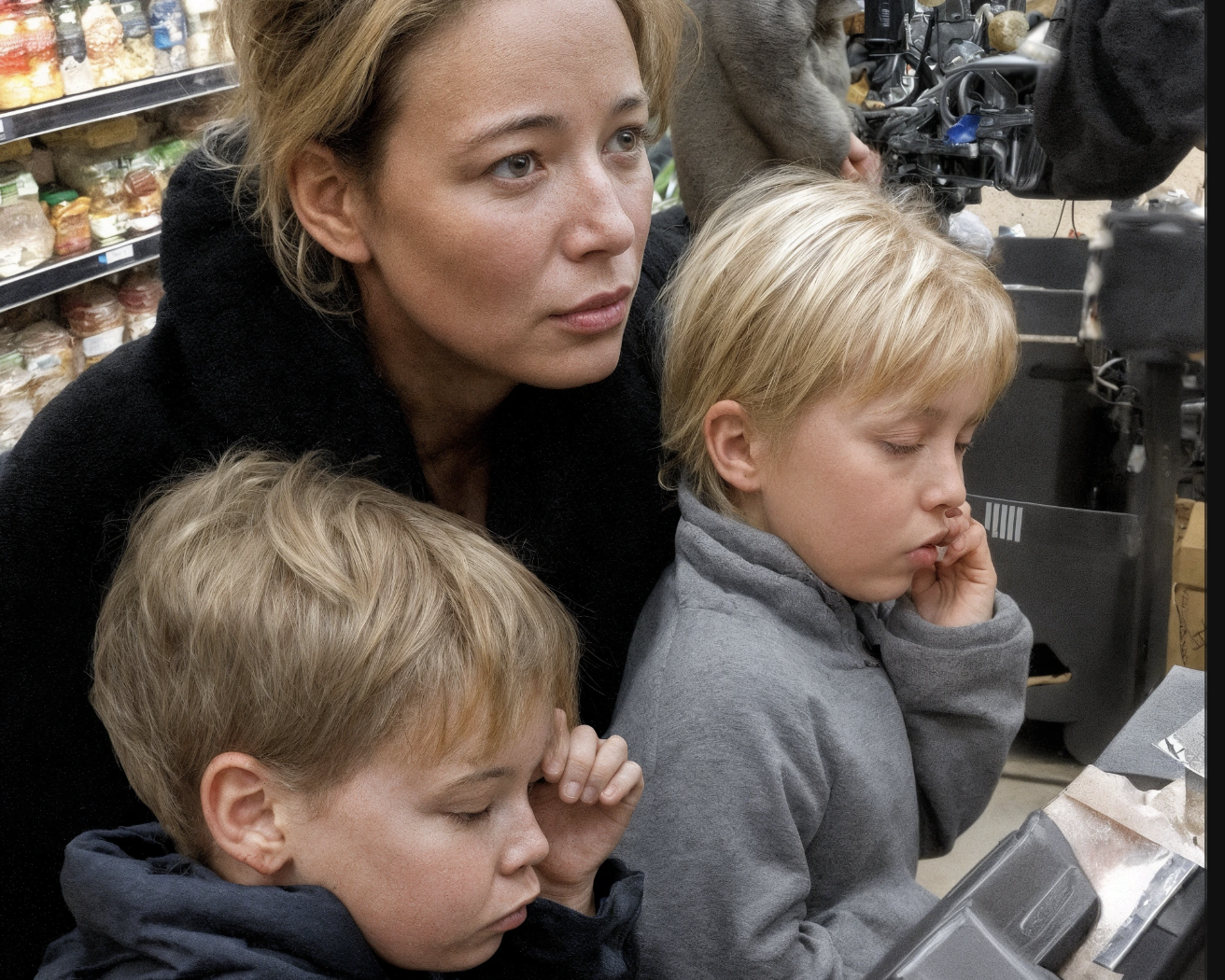
I’m 43 years old and I work morning shifts at a small supermarket on Main Street. To be honest, most days, I feel like I’m just trying to keep up while the world spins a bit too quickly. On some mornings, as I stand at the delivery area and watch the sunrise, I remind myself that just showing up is already half the battle.
This job isn’t glamorous. It’s not what we fantasize about as kids, but after everything our family has endured, I’ve come to appreciate the significance of stability. When I say “stable,” it means having a full refrigerator. When I say “stable,” it indicates that the lights stay on. When I say “stable,” it signifies that my daughter has a real shot at a brighter future. In the past, I yearned for more. Today, I’m content with just enough. Enough time, enough warmth, enough tranquility.
Key Insight: Stability is a quiet treasure that provides a sense of security.
My husband, Dan, has a full-time job at the community center as a maintenance worker. Whether it’s fixing leaking pipes, repairing broken toilets, or replacing cracked windows, he tackles everything that needs attention. He’s perpetually exhausted, with his hands always busy, yet he never voices a complaint. Not once. We both understand what’s at stake. When he returns home, there’s always dirt on his sleeves and love in his gaze.
Our daughter Maddie just turned 16. She’s a brilliant student, truly. With excellent grades, she is particularly captivated by the sciences, especially biology. She’s already compiled a list of colleges to which she wants to apply, most of them far from our small town and beyond our financial means. Sometimes, I find her gazing at the stars through her bedroom window, as if they were whispering only to her.
She incessantly speaks of scholarships.
“Mom, I just need one good one,” she says with her eyes sparkling.
However, those scholarships are as rare as gold dust. If she doesn’t get one… honestly, I don’t know how we would manage. Yet, we don’t voice those fears aloud. We simply continue to work, to save, to hope. I’ve started skipping lunch more often just to tuck an extra five dollars away for her future.
We aren’t exactly poor, but we’re close. Every month feels like attempting to solve a math equation with too many unknowns—rent, gas, groceries, medications, school supplies. Everything accumulates faster than our incomes can handle. No vacations unless it’s a cheap day trip, and dining out is reserved for birthdays. The last time we went out to eat, Maddie ordered fries as if they were an extravagant treat.
Despite everything, we are united. We love each other. We share our burdens together. That bond means more than words could ever convey. There’s an indestructible element to facing hardships as a team.
Anyway, it was a Saturday morning in early November, I believe. It was so cold that my breath created small white puffs as I walked to work. Saturdays at the store are sheer chaos—crying children, half-asleep parents, and a crowd stocking up as if an apocalypse were to hit come Sunday morning. I had already spilled coffee on my apron and set up a pallet of canned soups before the sun had even fully risen.
Around 10 o’clock, a woman entered the queue at my register. She looked to be about my age, perhaps a bit younger. Wearing a light jacket, her eyes conveyed fatigue. Accompanying her were two children—a small boy no older than three or four who held her hand while rubbing his eyes, and a little girl slightly older, staring at the apples in the cart as if they were made of gold. There was something in her posture—stiff and silent—that hinted she was fighting against the urge to crumble.
I greeted them as I typically do, with polite words, and began scanning the items. There wasn’t much in the cart, just essentials: apples, cereal, bread, milk, and a few canned goods. Nothing extravagant—just what someone thinks of when budgets are tight, not the joys of indulgence.
When I announced the total, she blinked, seemingly surprised by the amount. She didn’t respond immediately. Slowly, she reached into her coat pocket, as though that single action caused her physical pain.
Then she whispered, “Oh… you can remove the apples? And the cereal. We… we’ll manage somehow.”
Her voice cracked on the last word, as if she had been trying to prevent breaking down for weeks.
Her tone carried the weight of someone barely holding on. It felt like defeat wrapped in politeness, the tone taken by those who don’t wish to disturb.
The children didn’t throw tantrums. They didn’t ask for anything. They merely fell silent. A silence learned only by children who have witnessed their parents’ worries too many times. The little girl cast her gaze down at her shoes, as if she already comprehended the answer was always “maybe next time.”
Something in me… shattered. It didn’t make rational sense. Just a deep and immediate ache urging me to take action.
Before she could pull out her card, I slid mine into the terminal. My hands moved before my thoughts could catch up as if kindness were a muscle memory.
“It’s fine,” I said softly. “Just take them, please.”
I attempted to smile, but what emerged was a light and somewhat sad grin, as though I understood it was about more than just apples.
She looked at me as if I had placed a winning lottery ticket in her hand.
“I can’t reimburse you,” she murmured. In her eyes, shame was evident, but primarily there was absolute exhaustion.
“You don’t have to,” I replied, believing it with all the depth a human can feel something.
She nodded, grabbed the bags, breathed out a quick “thank you” like a prayer, and hurried out as if she feared collapsing if she lingered even a moment longer. The door chimed behind her, and for a fleeting moment, the store felt more silent.
It was just ten dollars. Apples and cereal. Nothing heroic. Nothing grand. Just a small act of kindness in a world that sometimes forgets how to be kind. I’ve seen individuals spend more than that on energy drinks and scratch-off tickets without blinking.
That night, I didn’t even mention it to Dan. It wasn’t a story. Just a moment. A silent act among an existence filled with quiet responsibilities.
But then came… Tuesday morning. I remember it clearly because I had mismatched socks on without realizing it.
It was a tranquil moment. A man with eight cans of cat food and a single powdered sugar donut was chatting about the weather when I noticed a police officer enter. He seemed to have a specific purpose, not just a cop grabbing a coffee and doing a routine check.
He wasn’t merely patrolling. His gaze scanned the aisles one by one as if he already knew what or who he was searching for.
His eyes were fixated directly on me. My stomach knotted as if I had swallowed a stone.
I froze. My first thought was: What has Maddie done now? Then: Has something happened to Dan? My mind rushed through every possible disaster scenario before I could even blink.
The officer approached my register, calm but determined.
“Are you the cashier who paid for the woman with two children? For the apples?” His tone wasn’t accusatory, but it was clearly more than a casual conversation.
My throat went dry. I felt as if I had been caught with my hand in the cookie jar for doing something wrong, even though I knew that wasn’t the case.
“Yes,” I said slowly. “Why?”
I could hear the uncertainty in my voice, trembling and thin.
He didn’t respond immediately. He merely stated, “Ma’am, I need you to call your manager.”
At that moment, my hands started shaking.
The panic rose so quickly I felt it in my throat. My heart pounded so loudly I could barely hear the customers shifting behind me in line.
<p“What? Why? Did I do something wrong?” My voice broke, and suddenly, I felt like a twelve-year-old again, as if I were being punished for something I didn’t understand.
“Ma’am,” he reiterated, gentle yet firm, “please call your manager.” He wasn’t threatening, but he wouldn’t leave without an answer.
So, I complied. My manager, Greg, arrived looking a bit bewildered. The officer pulled him aside. They spoke for perhaps thirty seconds. Greg’s eyebrows raised, then he looked at me as if I had just sprouted a second head.
Then he turned to me and said, “Take two hours off. Go with the officer. It’s… important.”
The way he stressed “important” made the situation feel even more serious.
I did not want to go. Who would? I was already envisioning the worst-case scenarios. But I took my coat and followed him outside. The air felt even colder than it had that morning.
We didn’t get into a police car. We didn’t head to the station. Instead, he simply began walking down Main Street as if it were an ordinary Tuesday.
We walked two blocks to a little cafe I’d passed countless times. I had always thought about going inside but never felt I had the time or money.
He held the door for me. The aroma of coffee and freshly baked bread wrapped around me like a warm embrace.
And there, sitting at a table by the window, was the woman from the store. With her children. Who were smiling. Who were waving at me. My heart raced in my chest, but for a different reason this time.
I stood rooted.
“What is… all this?”
I felt as if I were caught in a dream I hadn’t consented to.
The officer sat across from me and finally explained. His posture shifted, less official, more human.
“I’m their father,” he said gently. “I’ve been on an undercover assignment out of state for eleven months. I couldn’t come home. I couldn’t contact them. It was too risky.” Each word carried the weight of lost time and suppressed fear.
The woman nodded, her eyes shining once more.
I didn’t tell anyone,” she explained. “Not even my sister. I was terrified. And when the money started running low… the kids noticed.” She bore a profound fatigue that no amount of sleep could erase.
He continued, his voice softening: “When I returned, they shared what happened. What you did. She said you didn’t make her feel small. That you didn’t look away. I needed to thank you.”
He looked at me with a gratitude so solid that there was no room for doubt.
The little girl, Emma, slid a piece of paper toward me across the table. Her fingers barely trembled, as if this was the most vital part of the moment.
<p“We did this for you!” she said with the pride that only children possess.
It was a drawing. Me at the register with a giant red superhero cape. The children holding apples surrounded by sparkles. I had a slightly crooked smile and little stars over my head. It was perfect.
They even included a small heart over the “i” in “kind.” The sign read, THANK YOU FOR BEING KIND. FROM JAKE & EMMA.
I had to cover my mouth to keep from bursting into tears.
I didn’t even try to stop the tears. They came quickly and hot. There are moments that deserve your tears, and that one deserved every single one.
The officer smiled and said, “Lunch is on us. Order whatever you like.”
It was the first time in years I had heard someone say that.
So I did. A hot sandwich and a cup of coffee for which I didn’t have to point. Each bite tasted like pure grace.
We stayed there for nearly an hour. Talking. Laughing. The children showed me the drawings they had made. Their mother—her name is Lacey—shared how relieved she felt now that things had stabilized. That they had weathered the storm. I spoke to her about Maddie and her dreams, and Lacey nodded as if she fully understood.
Before I left, she hugged me tighter than any stranger ever had. It was the kind of hug that says thank you without needing words.
“Now we’re going to be okay,” she whispered. “Thank you… for being there on one of our worst days.” That statement settled within me like an anchor.
I returned to work as if my shoes barely touched the ground. Greg said nothing; he merely nodded when he saw me come back.
And then, because life has its way of surprising you, barely a week later, Greg called me to the back room. I presumed he wanted me to fill in for someone.
He shut the door. When that happens, it means something serious is afoot.
“I have news,” he said. “You’re getting promoted. Shift supervisor. Starting Monday.” For a second, I thought he was joking.
I looked at him as if he had just announced I had won the lottery. It didn’t feel real until he slid a piece of paper across the desk.
Then he handed me a letter. At the top was the city seal—I recognized it immediately.
It was from the officer. Typed with a computer, but the last line was handwritten: “Thank you.”
He had written directly to the headquarters about my kindness, attitude, and integrity. He said I was the kind of employee who enhances an entire community. Greg mentioned it was one of the nicest letters they had ever received.
I can’t even recall how I exited the office. I stayed in the break room, clutching that paper as if it were the most important thing I’d ever won. And perhaps, in a certain sense, it might have been.
All of this for apples. And cereal. Two items that represented survival for them, and purpose for me.
That’s the beauty of small acts of kindness. You never know who is watching you. Or how far they will go. Sometimes, they come around and return to you in ways you could never have anticipated.
And if I were to do it all over again? Even without the promotion or the thank you?
In a heartbeat. Every single time. Because people deserve to feel seen. Even when they’re just barely holding on.