On that frigid November night, finding my most gifted student curled up in a frosty parking garage shattered my heart into a thousand pieces. Yet, when he revealed why he was there, I instantly knew what needed to be done.
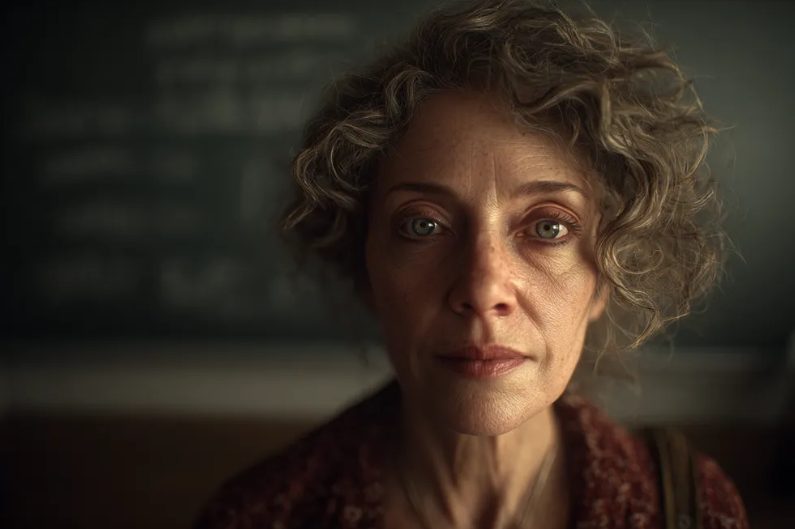
At 53 years old, I’ve been teaching physics at a high school in Ohio for over twenty years. My life has been filled with the children of others. Thousands of students have crossed through my classroom doors, learning about gravity and momentum, and I have repeatedly been moved when they finally grasp why all objects fall at the same rate regardless of their weight. The moment when the light bulbs go on in their eyes has always been my greatest resource—the proof of why I return to the same classroom year after year.
However, I have never had children of my own. That quiet, empty space has lurked in the shadows of my proudest days, even when everything seemed fine from the outside. My marriage ended after twelve years, partly because we couldn’t have children together and partly because my husband couldn’t bear the disappointment of repeated failures. The medical appointments, the hopeful yet ultimately negative tests slowly wore us down until nothing was left.
After my divorce, it was just me, my lesson plans, and an empty house that felt far too spacious for one. I thought this would be the tale of my life: the dedicated teacher who poured every maternal instinct into her students, then returned home to her microwaved dinner and papers to grade. I accepted this—at least I thought I had. I convinced myself that it was sufficient to love my students as if they were my own, even as solitude crept into my nights.
Then came Ethan. From the very first class, I sensed he was different from the others. While most students viewed equations and formulas as a burden, Ethan seemed to shine. He leaned forward in his desk as I explained complex theories, his eyes sparkling with curiosity.
“Ms. Carter, could you explain black holes in more detail? I read that time passes differently near them, but how is that possible?”
While most boys his age were thinking about weekend parties or video games, Ethan was exploring the secrets of the universe. He stayed after school for hours to solve problems I hadn’t even assigned. Sometimes, he brought articles he had found and asked how credible they were—he was thirsty for knowledge. Driving home, I often smiled at his questions and enthusiasm. “This boy is going to change the world,” I told myself as I opened my door to another quiet evening.
Ethan could see beauty even in the most intricate equations. While others merely saw numbers and symbols, he perceived poetry. He once said that physics is like “reading God’s language written over the universe,” and I believed him. He understood that physics is not just a collection of formulas but a comprehension of how everything connects in the cosmos.
In his eleventh grade, he won the regional science competition with his project on gravitational waves. I nearly cried during his presentation from pride. His parents didn’t show up for the announcement, but I was there, clapping louder than anyone else in the room. In the summer, he took advanced online courses and casually read physics textbooks for fun.
At the beginning of his twelfth grade, I could hardly wait to see how far he would go. I envisioned universities competing for him, scholarship offers waiting for him everywhere. I imagined him stepping onto the graduation stage adorned with medals, ready to fulfill his destiny.
Then everything changed. At first, it was little things: late or missing homework. The boy who used to arrive early was now barely making it in by the bell. The light that had been so bright started to dim, and I couldn’t understand why. Dark circles began to appear under his eyes, and the spark I had grown so fond of faded day by day.
“Ethan, is everything okay?” I asked repeatedly after class. “You seem really tired lately.”
He simply shrugged and muttered, “I’m fine, Ms. Carter. Just senior year stress, you know…”
But I knew it was more than simple stress. I had seen exhausted students before. This was something entirely different. He often rested his head on the desk during class, something that had never happened before. Sometimes he just stared at the board as if the words couldn’t reach him. His brilliant questions dwindled, then disappeared completely. I attempted to talk to him several times, but he always deflected with the same two words: “I’m fine.” Those words became his shield against anyone trying to get closer.
The truth was that Ethan was far from fine. And one cold November Saturday night, I discovered just how unwell he truly was.
That Saturday started just like any other weekend. I had caught a terrible cold and realized I had run out of cough syrup. The temperature had dropped below freezing, and the rain was increasingly turning to sleet. It was the kind of evening that felt unpleasant even to step out to the mailbox. I didn’t want to leave my warm home, but I knew I couldn’t sleep unless I got something for my cough. I bundled up in a thick coat and told myself it would only take ten minutes.
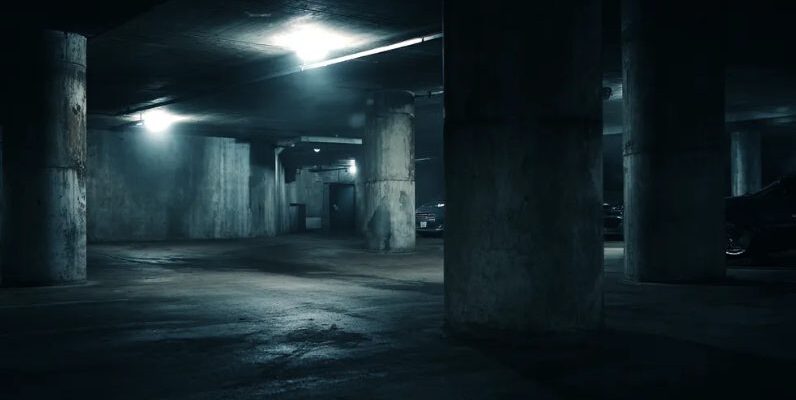
I parked in the third-level covered garage of the downtown grocery store. That dimly lit place always made me a little uneasy, but at least it was dry. As I walked toward the entrance, something moved in my peripheral vision. A dark silhouette was slumped against a distant wall, tucked behind a concrete pillar. At first, I thought it was just a pile of old clothes or perhaps a stray person’s belongings.
Then the figure stirred. My heart raced as I realized the dark figure was a person. Someone was curled up on the cold concrete floor, using a backpack as a pillow. My rational mind whispered to keep walking, not to get involved. It’s not safe, I kept saying to myself. Don’t get involved. But my feet carried me closer anyway.
I carefully approached, the echoes of my footsteps filling the empty garage. As I got closer, more details emerged: a worn-out coat pulled tightly around them, a pair of sneakers I recognized, a familiar profile.
“Ethan?” I whispered, hardly believing my eyes.
His eyes shot open wide, filled with fear and confusion. For a moment, he looked like a wild animal caught in a sudden spotlight.
“Ms. Carter, please,” he stammered, sitting up abruptly. “Please, don’t tell anyone. Please.”
It felt like a punch to the gut. My bright, wonderful student had become a boy sleeping on the cold concrete floor of a parking garage, out in the freezing air. It was so wrong, so unbearably sad, that I could hardly catch my breath for a moment.
“Dear, what are you doing here?” I asked worriedly. “Why are you sleeping in a parking garage?”
The boy lowered his head, clenching his fists. He was quiet for a few moments before he spoke softly.
“They wouldn’t even notice if I disappeared,” he said. “My dad and stepmom… they throw parties and invite strangers. The whole place is filled with loud people, and sometimes I can’t even get into my room.”
I saw how hard it was for him to voice what a child should never have to explain. Tears welled in my eyes as everything began to fall into place: the late homework, the exhaustion, the dimming light in his eyes—I finally understood.
“I just couldn’t stay there tonight,” he continued. “It was another party, some guy was shouting and throwing things. I grabbed my backpack and left. I’ve been sleeping here for three nights.”
Three nights. This boy had spent three nights on the concrete while I slept in a cozy bed, completely unaware.
“Come on,” I said, extending my hand toward him. “I’ll take you home.”
“Ms. Carter, I can’t…” he started, but I interrupted.
“Yes, you can,” I replied firmly. “And you will. My student is not sleeping in a parking garage.”
That night, I made him soup and grilled cheese sandwiches. It was the simplest dinner I knew, but as he devoured it, it felt like I was serving a feast. I gave him clean clothes and a warm blanket. He took a long, hot shower, and when he came out, the old Ethan stood before me again: hair clinging to his forehead, cheeks flushed from the warmth, and for the first time in weeks, I saw traces of relief on his face. He fell asleep on my couch, and I watched from my armchair, knowing everything had changed.
The next morning, Ethan tried to convince me that this was just temporary and that he could manage alone. But I had made up my mind. No child should have to choose between sleeping on concrete and a dangerous home.
Getting custody proved challenging. Court hearings, social workers, endless paperwork awaited me. Ethan’s father, Mr. Walker, fought me every step of the way. Not because he wanted his son but because his pride couldn’t bear the thought of a teacher “taking” his child away.
The first hearing was tough. Mr. Walker showed up smelling of whiskey at ten in the morning, his wife in a shiny dress that was completely inappropriate for the courthouse. She constantly checked her phone and rolled her eyes every time someone mentioned Ethan’s well-being.
“You think you can just take my son away from me?” Mr. Walker muttered, pointing a trembling finger at me. “I’ve raised him just fine.”
When Ethan testified about the conditions at home, his voice trembled, but he didn’t back down.
“They don’t care about me,” he stated clearly. “My stepmom calls me trash, says I’m worthless. My dad doesn’t pay attention to me at all. They bring strangers into the house, partying until dawn. I can’t study, I can’t sleep, and I don’t feel safe.”
The judge’s expression grew somber as he listened to the details. When he granted me temporary custody, Mrs. Walker laughed and muttered, “At least we’re rid of him.” Six months later, custody became permanent.
Watching Ethan flourish in my home was like witnessing a flower come back to life after a long drought. He started sleeping through the night again, his grades improved, he won science competitions and received scholarships. Each evening, we sat at the kitchen table: he solved physics problems while I graded papers. Sometimes he accidentally called me “Mom,” then blushed and apologized. I never corrected him.
Three years later, Ethan graduated as valedictorian and won a full scholarship to a prestigious university for astrophysics. His research on dark matter had already caught the attention of professors during his undergraduate studies. At the university’s graduation ceremony, I sat in the audience in my finest dress, prouder than ever. Mr. and Mrs. Walker were also present; somehow, they managed to look sober and decent for the cameras.
When Ethan accepted his award, he unexpectedly asked for a microphone.
“I want to say something,” he began. “I wouldn’t be standing here today if it weren’t for a special person in my life. Not my biological father, who was drunk much of my childhood. Not my stepmother, who made it clear she didn’t want me. The person who saved my life is sitting in the third row.”
He looked directly at me.
“Ms. Carter found me when I was sleeping in a parking garage during high school. She could have easily walked past me, but she didn’t. She took me in, fought for me in court, and became the mother I never knew.”
He walked off the stage and draped the medal around my neck.
“This belongs to you, Mom.”
The room erupted in applause. Everyone was crying, including me. Mr. Walker’s face was red with shame, and his wife was already making her way towards the exit. But Ethan wasn’t finished.
“I’m starting a foundation for children who are in situations like mine,” he declared. “For those who slip through the cracks and have no safe home. And I want everyone to know one more thing.
He took my hand and squeezed it.
“Last month, I officially changed my name. I’m proud to carry the name of the woman who saved my life.”
As the audience stood to applaud us, I realized my life hadn’t ended up being the quiet, childless story I had expected. At 53, I finally became a mother to the child who needed me the most. Sometimes family isn’t defined by blood. Sometimes it’s by love, by choice, and being there when someone needs us the most.
This work was inspired by real events and people, though fictional elements have been added for creative purposes. Names, characters, and details have been changed to protect privacy and enhance the story. Any similarities to actual persons, living or dead, or actual events are purely coincidental and unintended by the author. The author and publisher do not warrant the accuracy of the events or the portrayal of the characters and are not responsible for any misunderstanding. The story is presented as is, and the views expressed by the characters do not reflect those of the author or publisher.