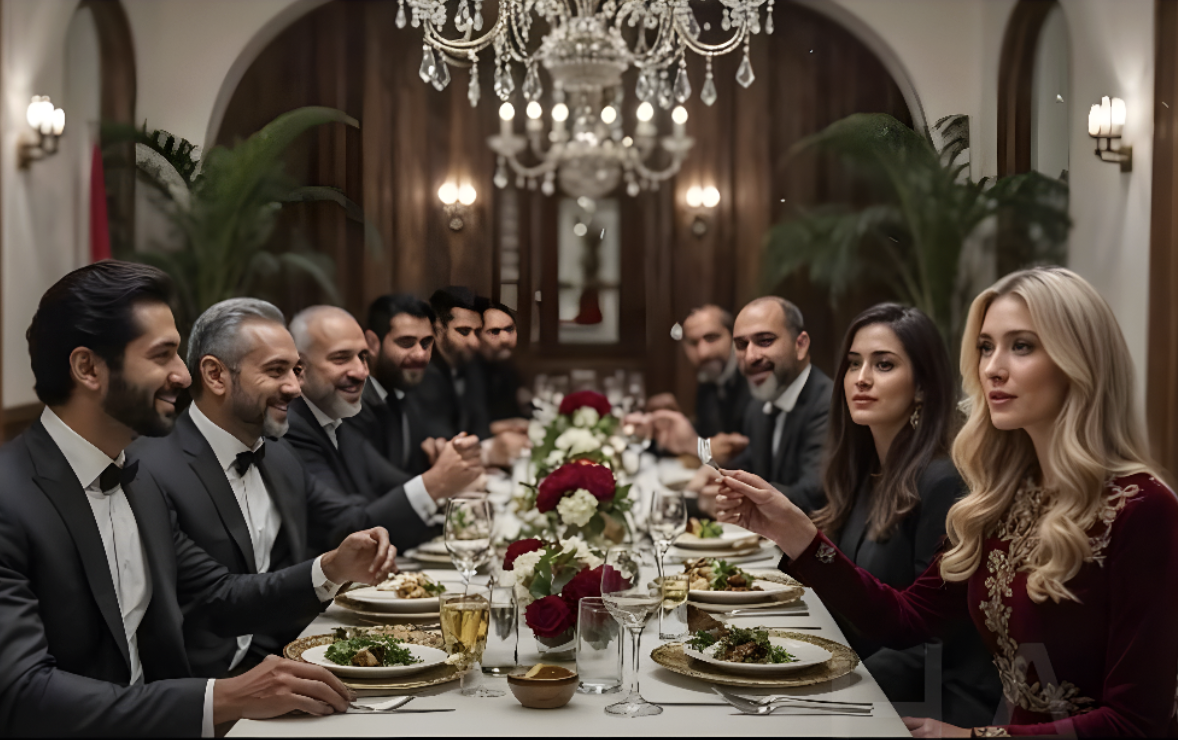
The joyous sounds spilling from the private room at the Damascus Rose Restaurant resembled the delicate chime of crystal. I remained still, my fork hovering over the untouched lamb, observing twelve members of the Almanzor family conversing rapidly in Arabic—words flowing past me like water over stones. Supposedly, they assumed I didn’t grasp a thing.
Tariq, my fiancé, occupied the head of the table, his hand resting heavily on my shoulder, offering no translations. His mother, Leila, observed me with sharp, discerning eyes, the faintest smile gracing her lips, as if she already comprehended how the evening would unfold.
“She doesn’t even know how to brew coffee,” Tariq muttered to his brother in Arabic, amusement evident in his tone. “Just yesterday, she utilized a machine.”
Omar nearly gagged on his wine. “A machine? You intend to marry _that_?”
I sipped my water, maintaining an expression of calm—the same one I had donned for the past six months since Tariq proposed. They perceived me as the oblivious American girl lost in translation. However, they were mistaken.
I beamed sweetly when Tariq leaned in. “My mother mentions that you look stunning tonight, _Habibti_.”
In reality, Leila had merely suggested that my dress appeared cheap. I expressed gratitude nonetheless.
As Tariq’s father, Hassan, lifted his glass and proclaimed, “To family—and to new beginnings,” his daughter whispered in Arabic, “New troubles.” Laughter erupted around the table. Tariq smoothly added, “The kind of troubles that she remains blissfully unaware of.”
I joined in the laughter, meticulously recording each word in my mind.
In the restroom, I peeked at my phone. A message awaited me from James Chen—the leader of my father’s security division. _Audio files from the previous three family dinner gatherings have been transcribed and translated. Your father inquires if you are prepared._
_Not quite yet,_ I typed back. _I first require recordings from business meetings._
Eight years prior, I had been Sophie Martinez—naïve and freshly graduated, stepping into my father’s consulting firm in Dubai. I acquired knowledge in Arabic and immersed myself in the local culture until fluency became second nature. By the time I returned to Boston to assume the role of COO, I could negotiate in classical Arabic with greater ease than many native speakers.
And then came Tariq Al-Mansur: strikingly handsome, a graduate from Harvard, and heir to a powerful Saudi conglomerate. He seemed to be the ideal conduit into a market that my father’s company could never completely penetrate. Or so I believed.
He pursued me with undeniable charm, proposing marriage within months. I accepted—not out of love, but for strategic reasons. What I failed to realize was that his intentions were far colder than mine.
The first family dinner had been revealing. They ridiculed my attire, my profession, and even my ability to conceive—all while speaking in Arabic. Tariq joined in their laughter, labeling me as “too American,” “too self-sufficient.” I had managed a sweet smile, pretending to be bewildered, and subsequently returned home, starting a list of every slight.
Now, two months later, I unraveled their true agenda. Tariq’s company was in cahoots with our foremost competitor, Blackstone Consulting, to pilfer Martinez Global’s client databases and strategic plans. He exploited our relationship as a means to access, confident I remained too ignorant to detect the deception.
What he didn’t grasp was that I was recording every word via modified jewelry—his own gifts revamped by my father’s tech team.
Tomorrow, he would meet with Qatari investors to unveil the purloined information. He believed it would render him invulnerable. Instead, it would lead to his downfall.
The lengthy dinner continued. Leila interrogated me about my career. “After getting married, will you continue working?”
I glanced at Tariq. “We’ll reach a consensus together.”
“A wife’s primary obligation is to her family,” she asserted. “Men engage in careers.”
“Certainly,” I replied softly. “Family holds utmost significance.”
They all appeared at ease, none suspecting I had already signed a ten-year executive contract.
As the dinner concluded, Tariq chauffeured me home, beaming with satisfaction. “You were flawless. They adore you.”
“Really?” I queried, feigning surprise.
“Without a doubt. My mother remarked that you are charming and courteous.”
He pressed a kiss to my hand. I smiled, replying, “That means a great deal.”
Once he departed, I poured myself a glass of wine and perused the transcript from the night’s dinner. One particular line struck me with chilling clarity:
_“Sophie shares everything with me,”_ Tariq boasted to his father. _“She believes she’s impressing me with her business savvy. She remains unaware that she’s divulging everything necessary to undermine their bid.”_
But I had never disclosed our contracts in Abu Dhabi or Qatar. This implied a mole existed within Martinez Global.
James verified this: Richard Torres, my father’s long-serving VP in Dubai—mentor, colleague, traitor. We would confront him in the morning.
At 7:45 a.m., I entered my father’s office with two coffees in hand. He was already poring over evidence: bank transfers, emails, every act of treachery outlined. Richard appeared, smiling, but his face faded to pallor as he spotted the folder.
“I was overwhelmed with debt,” he implored. “They offered financial assistance. I didn’t consider—”
“Thoughts of selling trade secrets seemed to cross your mind,” Patricia Chen from Legal interjected.
My father presented him with two alternatives: resign, confess, and cooperate—or face legal action. Richard signed every page, his hands visibly trembling.
As he left, my father turned to me. “Are you prepared for Tariq’s meeting?”
“More than equipped.”
In the afternoon, Tariq called. “Important investors wish to convene face-to-face. Come with me, _Habibti._ They appreciate family.”
“Naturally,” I affirmed.
At 1:30, he collected me, brimming with confidence. Inside the elevator, ascending to the hotel’s uppermost floor, he adjusted his tie. “After today, Almanzor Holdings will lead the Gulf market.”
“How?” I inquired.
“By claiming what they don’t rightfully deserve. Survival favors the strong.”
He remained blissfully ignorant of the trap laid out ahead.
Upon entering the executive suite, I found Sheikh Abdullah Al-Thani—one of the Gulf’s most esteemed investors—accompanied by two Qatari officials and my father.
Tariq froze. “I don’t … comprehend.”
“This was to be your chance to present acquired strategies,” Sheikh Abdullah stated icily. “Instead, it serves as your reckoning.”
The Sheikh placed documents on the table: Richard Torres’s confession, financial records, transcripts from our previous dinners. “Did you know she understood every word?”
Tariq’s gaze met mine, dawning realization evident.
I then spoke in flawless Arabic. “Curious about the purpose of this meeting? It revolves around justice. It highlights the consequences of underestimating those you intend to deceive.”
He sank into his chair.
The Sheikh continued. “Your actions breach international business law. Tomorrow, every prominent investor will learn of your attempts.”
“My family—please, they were unaware—”
“They mocked her alongside you,” the Sheikh stated. “They share your disgrace.”
My father’s voice was a calm steel. “You will provide a comprehensive account of all documents you pilfered and every contact at Blackstone. You’ll testify under oath. And you will cease all contact with my daughter.”
Tariq nodded, dazed.
I gazed at him one final time. “You once wondered why I exerted so much effort. Because I never desired to rely on someone like you.”
The meeting concluded with a sense of quiet finality. Tariq remained behind to deliver his statement.
By evening, the repercussions commenced. Sheikh Abdullah’s office issued a declaration severing all connections with the Almanzors: _a fundamental deficiency of integrity inconsistent with our standards._ Within hours, their contracts crumbled.
Richard cooperated fully; legal charges were shelved, but his career met its end. Blackstone rushed to dissociate itself, providing documents to bolster our lawsuit.
Leila contacted me, enraged. “You must meet with me. We ought to resolve this.”
“In my world, Mrs. Almanzor, it’s called fraud,” I responded in Arabic. “And we pursue justice for it.”
Her gasp reverberated through the line. “You speak Arabic?”
“All this time,” I replied, and then disconnected the call.
Three days later, Martinez Global received a settlement proposition: the complete $200 million along with legal fees. We accepted. The victory transcended mere finances—it held moral significance. The tale quietly circulated through international networks: a cautionary tale against misjudging silence for ignorance.
A week later, a courier presented me with a handwritten letter from Tariq.
_You were correct. I manipulated you. I mocked you. I rationalized it as mere business. I now realize I was wrong. My family has lost everything. I’m departing Boston. I don’t expect forgiveness, but I wish you to know you outplayed me. You were always more astute than I acknowledged._
I captured a photograph of the letter for the record, then proceeded to shred it. Documentation is vital, after all.
Three weeks later, I found myself again at the Damascus Rose restaurant—identical chandeliers but differing company. Sheikh Abdullah hosted a dinner to honor justice and collaboration.
“To Sophie Martinez,” he declared, alternating between Arabic and English, “who reminded us never to underestimate a quiet woman.”
Laughter resonated throughout the room.
Later, he pulled me aside. “My daughter studies business at Oxford. She aspires to emulate you.”
I smiled. “Then the future is promising.”
As I drove home through the illuminated streets of Boston, reflections of everything—the dinner gatherings, the barbs, the betrayal, and the lessons learned—filled my thoughts. A final message illuminated my phone.
_This is Amira. I apologize for how we treated you. Observing our family unravel has imparted lessons more profound than pride ever could. Please refrain from responding._
I remained silent, but chose to save it. Proof that some lessons carve scars that can transform individuals.
The engagement ring lay stored away, a reminder of hubris and miscalculation. One day, I would sell it and donate the proceeds to women launching their enterprises. For now, it remained a testament: silence does not equate weakness; patience embodies strength.
Eight years spent in Dubai had refined my understanding of strategic maneuvering, yet this ordeal imparted a greater wisdom—the significance of playing the long game, the virtue of self-restraint, and the strength inherent in being underestimated.
I poured myself another glass of wine and gazed out at the city skyline. The following day, I would finalize our new expansion in Qatar. Next month, I would ascend to the role of Executive Vice President of Global Operations.
Tonight, I permitted myself a solitary toast,
To lessons acquired. To quiet triumphs.
To fresh beginnings.
In Arabic, the words resonated as if they were entirely my own.