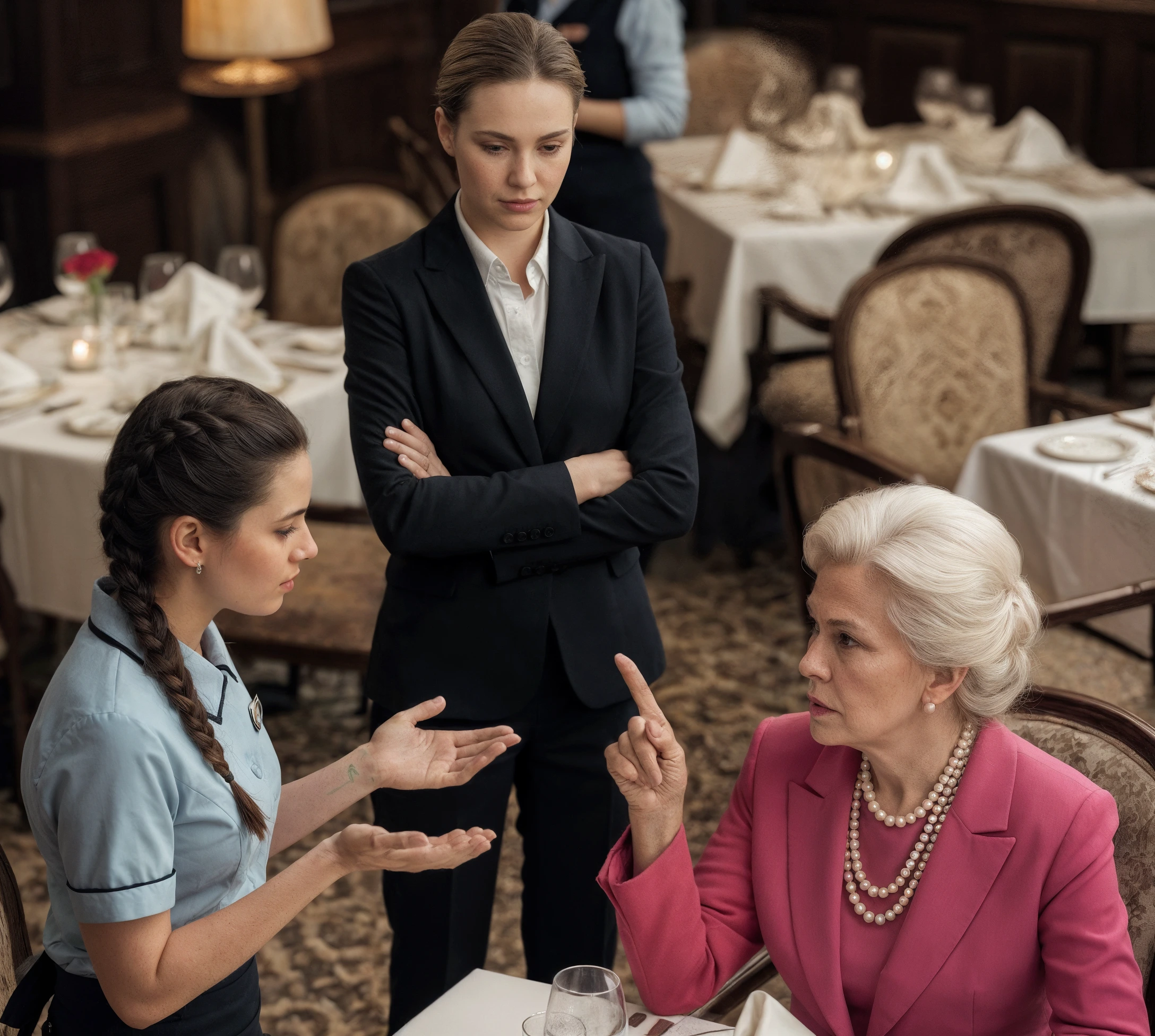
What would you do if you were a humble waitress and noticed a billionaire’s deaf mother being ignored by everyone in a fancy restaurant? Elena never anticipated that her knowledge of sign language would alter her life forever. It was 10:30 PM when, after a grueling 14-hour shift, Elena finally had a moment to sit down.
Her feet ached in worn shoes, and her back was desperately pleading for relief that wasn’t coming soon. The La Perla del Caribe restaurant, located in the heart of Cancun’s hotel zone, catered exclusively to the wealthy elite. Marble walls gleamed under crystal chandeliers, with tables dressed in linen and adorned with solid silver cutlery. Elena was polishing a crystal glass worth more than her monthly salary when Mrs. Herrera, dressed all in black, stormed in.
At 52, she had perfected the art of humiliating her employees.
“Elena, put on a clean uniform. You look like a beggar,” she spat with a sharp voice.
“This is my only clean uniform, ma’am. The other is at the laundry,” Elena replied calmly.
Mrs. Herrera approached with menacing footsteps.
“Are you making excuses? There are 50 women who would kill for your job.”
“I’m sorry, ma’am, it won’t happen again,” murmured Elena. However, her heart beat with unwavering resolve. Elena didn’t work for pride; instead, she worked out of pure love for her younger sister, Sofía.
Sofía was 16 years old and was born deaf. Her expressive eyes were her way of speaking to the world. After their parents passed away, when Elena was 22 and Sofía just 10, she became everything to that little girl. Every insult she endured, every extra hour, every double shift that wore her down, was all for Sofía. The specialized school cost more than half of Elena’s monthly earnings, but seeing her sister learn and dream of becoming an artist was worth any sacrifice.
Elena returned to the dining area when the main doors swung open. The maître announced:
“Mr. Julián Valdés and Mrs. Carmen Valdés.”
The entire restaurant held its breath. Julián Valdés was a legend in Cancun. At 38, he had built a hotel empire. He wore a dark gray Armani suit, and his presence filled the space with natural authority. But Elena’s attention was on the elderly woman walking beside him. Mrs. Carmen Valdés appeared to be around 65, with silver hair and a stylish dark blue dress.
Her green eyes scanned the restaurant with a mix of curiosity and something else Elena recognized: loneliness. Mrs. Herrera rushed to the main table.
“Mr. Valdés, what an honor. We have prepared our finest table for you.”
Julián nodded as he guided his mother, but Elena noticed something. Mrs. Carmen seemed disconnected from the conversation. The table was beside windows with an ocean view. Mrs. Herrera ordered Elena:
“You serve Mr. Valdés’s table, and you better not make any mistakes, or tomorrow you’ll be out on the street.”
Elena nodded and approached with her best professional smile.
“Good evening, Mr. Valdés, Mrs. Valdés. My name is Elena, and I will be your server this evening. May I offer you something to drink?”
Julián ordered a whisky and looked at his mother.
“Mom, would you like your white wine?”
Carmen didn’t respond. She gazed out of the window with a distant expression. Julián repeated the question, touching her arm. Again, nothing.
“Bring her a Chardonnay,” he said in frustration.
Elena was about to step away when something stopped her. She had seen that same expression of isolation in Sofía hundreds of times. She had to try. Positioning herself in front of Carmen, she signed:
“Good evening, ma’am. It’s a pleasure to meet you.”
The effect was immediate. Carmen turned her head sharply. Her eyes widened in surprise and lit up with joy. Julián dropped his phone, staring at Elena in shock.
“You know sign language?”
Elena nodded.
“Yes, Mr. Valdés. My younger sister is deaf.”
Carmen quickly signed:
“No one has spoken to me directly in months. My son always orders for me. It’s as if I’m invisible.”
Elena replied:
“You are not invisible to me. May I recommend the salmon with butter and lemon?”
Carmen’s smile was radiant. Julián watched, amazed. In all the upscale restaurants, no one had ever taken the effort to communicate directly with his mother. Mrs. Herrera approached, alarmed.
“Mr. Valdés, I apologize. Elena is new and does not understand the protocols. Allow me to assign you another server.”
Julián raised his hand to stop her.
“That won’t be necessary. Elena is exactly what we need.”
Mrs. Herrera walked away shooting Elena a look that promised revenge. For the next two hours, Elena served the table with a dedication that went far beyond professional service. Each time she brought a dish, she signed with Carmen, describing the ingredients, asking if she needed anything else, sharing small jokes that made the elderly woman laugh. Julián watched, fascinated. He admired not only Elena’s fluency but also her genuine warmth toward his mother.
She was not condescending; she treated Carmen as a complete person. When dessert arrived, Carmen was glowing, laughing, and signing animatedly with Elena. As Elena cleared the table, Carmen stopped her by touching her arm. She signed:
“You have a special gift. Your sister has your same kindness.”
Elena felt tears welling up in her eyes.
“My sister Sofía is stronger and braver than I am. She studies art at a specialized school. She dreams of becoming a painter.”
Carmen applauded joyfully.
“I’d love to meet her.”
Julián interjected:
“So would I. Any sister of someone as special as you must be extraordinary.”
Elena blushed.
The evening ended with Carmen hugging Elena at the entrance. It was something out of protocol, but no one dared to question it. Carmen signed:
“Thank you. You’ve given me something I haven’t felt in a long time: to be seen and heard.”
Elena replied with trembling hands:
“It was a pleasure. I hope to see you again soon.”
As the Valdés family departed, Elena returned, fully aware that she had broken rules and that Mrs. Herrera wouldn’t let her off the hook easily. She didn’t have to wait long. Mrs. Herrera intercepted her.
“In my office. Now.”
Elena followed her, stomach twisting with anxiety. The office was small and oppressive.
“Who do you think you are to break protocol with our most important client? Your behavior was inappropriate.”
Elena took a deep breath.
“With all due respect, ma’am. I was just trying to provide better service. Mrs. Valdés is deaf, and I can communicate with her, I thought…”
The woman interrupted her with a cruel laugh.
“I don’t pay you to think. I pay you to serve, clean, and keep your mouth shut. You are replaceable.”
Every word felt like a verbal punch. Elena felt humiliation wash over her but refused to lower her gaze.
“I understand, ma’am.”
The director moved even closer.
“From tomorrow, you will work the morning shift at 5 AM. You will clean the bathrooms, take out the trash, and prepare the restaurant all by yourself. And if you dare to break protocol again, you’ll be on the street.”
The message was clear: punishment.
Elena returned to her tiny apartment just before midnight, utterly exhausted. Sofía was awake, drawing, her extraordinary talent visible in every stroke. When she saw Elena, her face lit up.
“Sister, you’re late,” she signed with concern. “Did you have trouble?”
Elena sat down and recounted her experience with Carmen, the connection they shared. Sofía’s eyes sparkled.
“You did something beautiful. You restored her dignity.”
Elena also shared Mrs. Herrera’s punishment. Sofía frowned.
“That woman is cruel. Why does she hate you?”
Elena signed:
“I think it irritates her that I won’t break. But I won’t. I will stay strong for you.”
Tears flowed freely down Sofía’s cheeks.
“I don’t want you to suffer for me.”
Elena gently wiped away her tears and signed firmly:
“Your happiness is my happiness. Your success is my success. Every sacrifice I make is an investment in your bright future. Never forget that.”
The two sisters embraced silently, finding solace in the unbreakable bond that united them. That night, as Elena tried to sleep in her single bed, she couldn’t shake off the memory of Julián Valdés’s green eyes looking at her with what seemed like respect and admiration.
But above all, she remembered the pure joy on Carmen’s face. If that moment of genuine connection cost her enduring more cruelty from Mrs. Herrera, Elena was willing to pay that price. The following days turned into a hell crafted specifically by Mrs. Herrera. Elena arrived at the restaurant at 5 AM when the sky was still dark and Cancun’s streets had just begun to wake. Her tasks included scrubbing bathrooms with a toothbrush, as insisted by Mrs. Herrera, carrying garbage bags heavier than herself, and preparing the entire mise en place at the restaurant all on her own.
By the time other staff arrived at 8, Elena had already clocked three hours of work. She then continued with her regular shift until 10 PM. Seventeen-hour days left her feeling utterly exhausted. But Elena refused to complain. She refused to give Mrs. Herrera the satisfaction of seeing her break.
One week after her encounter with the Valdés family, Elena was cleaning tables after the lunch shift when the restaurant’s main door swung open. To her surprise, Julián Valdés entered alone, without a reservation. His presence immediately straightened up all the staff, including Mrs. Herrera, who practically raced from her office to receive him.
“Mr. Valdés, what a pleasant surprise. Would you like a table for lunch? Our chef can prepare anything…” she began with her rehearsed speech.
Julián interrupted her with a wave of his hand.
“Thank you, Mrs. Herrera, but I haven’t come to eat. I’ve come to talk to Elena.”
The ensuing silence was so profound that one could hear the buzzing of the air conditioning. All eyes turned to Elena, who felt her heart stop for a moment. Mrs. Herrera blinked several times, clearly flabbergasted.
“With Elena? But, Mr. Valdés, if you need anything, I can personally…”
“I need to talk to Elena,” Julián repeated firmly but without harshness. “Elena, can we talk somewhere private?”
Elena glanced at Mrs. Herrera, whose face had gone through various shades of red before she nodded stiffly.
“You can use the meeting room,” she said in a strained voice.
The meeting room was a small space on the second floor of the restaurant, usually used for small private events. Elena led Julián there, her hands sweaty and her heart pounding like a drum. Once inside, the door closed, Julián faced her with a serious but not threatening expression.
“Elena, first of all, I want to thank you for what you did for my mother last week.”
His voice was warm and genuine. Elena didn’t know what to say.
“It was nothing, Mr. Valdés. I just did what any decent person would do.”
Julián shook his head.
“No, you didn’t. Most people ignore my mother as if she were furniture. You saw her, you listened to her, and treated her with dignity.”
He paused before continuing.
“My mother hasn’t stopped talking about you. She asks me every day if we can go back to the restaurant just to see you.”
Elena felt warmth spreading in her chest.
“Carmen is a wonderful woman. It was an honor to be able to communicate with her.”
Julián took a step closer to her.
“I have a proposition for you, Elena. My foundation is organizing a charity gala in two weeks. It’s a huge event with over 300 guests, including politicians, entrepreneurs, and celebrities. My mother will be attending with me, but as always, she will end up feeling isolated since no one knows how to communicate with her.”
Elena sensed where he was headed. Julián continued:
“I want to hire you as my mother’s personal interpreter during the gala. It would just be for that evening, but I would pay you 10,000 pesos.”
The amount hit her like a lightning bolt. 10,000 pesos were almost half of what she earned in an entire month working 17 hours a day at the restaurant. It would be enough to pay for two months of Sofía’s school in advance, with some left over to buy the new art supplies her sister desperately needed.
“I don’t know what to say,” Elena murmured, feeling tears welling in her eyes.
“Just say yes,” Julián replied with a small but genuine smile. “My mother deserves someone who truly cares about the chance to communicate with her, not just her son translating for her quickly all evening.”
Elena took a deep breath, her mind racing. Accepting meant asking Mrs. Herrera for permission to take that night off, which would likely unleash even more wrath and punishments. But the image of Sofía, with her dreams of becoming an artist and her need for specialized education and materials, outweighed any fears.
“I accept, Mr. Valdés. It would be an honor to assist Carmen.”
The smile that spread across Julián’s face was so warm it completely transformed his usually serious features.
When Elena returned to the main floor of the restaurant, Mrs. Herrera was waiting for her with crossed arms and a suspicious, toxic expression.
“What did Mr. Valdés want from you?”
The tone implied Elena had done something inappropriate.
“He hired me as an interpreter for an event for his foundation,” Elena replied simply, refusing to be intimidated.
Mrs. Herrera narrowed her eyes.
“And you expect me to give you permission to miss work?”
Elena kept her voice steady.
“The event is on a Saturday night. I usually don’t work Saturdays.”
Mrs. Herrera smiled cruelly.
“Not anymore. I just changed the shifts. You will work every Saturday this month. Double shifts.”
The malice in her voice was palpable. Elena felt a surge of indignation, but before she could respond, Julián’s voice resonated from the stairs.
“Mrs. Herrera, I’m afraid that won’t be possible.”
Julián descended the stairs with the natural authority of someone accustomed to being obeyed.
“Elena will need that Saturday off because she will be working for me. I’m sure that the owner of this restaurant, who happens to be a personal friend of mine and a business partner, will have no problem approving her absence. Should I call him now to confirm?”
The color drained dramatically from Mrs. Herrera’s face. Her mouth opened and closed like a fish out of water.
“No, no, Mr. Valdés, of course Elena can have the evening off. No problem, absolutely.”
Her smile was so false it was almost comical.
Julián nodded, satisfied.
“Perfect, Elena. My assistant will contact you with all the details. Thanks again.”
With that, he left, leaving Elena standing in the main room with a sense of victory she had never experienced in that place. But the victory came at a price. As soon as Julián exited the door, Mrs. Herrera grabbed Elena’s arm painfully and dragged her into her office.
“You think you’re very clever, don’t you?” she hissed with pure venom in every word. “Do you think that because Mr. Valdés paid you a bit of attention that you’re special now? Let me tell you something, stupid girl. People like you don’t belong in the world of people like him. You’re an uneducated waitress, without family or anything. He’ll tire of you in two weeks and you’ll come crawling back to me, begging for your job.”
Every word was a deliberate stab meant to destroy Elena’s self-esteem, but something had changed. Elena had seen in Julián and Carmen’s eyes a genuine respect, something Mrs. Herrera had never given her. She lifted her gaze and looked directly into her eyes.
“Maybe you’re right, Mrs. Herrera,” Elena said calmly but firmly. “Perhaps I’m just an uneducated waitress, but at least I know how to treat people with dignity, which you clearly never learned.”
The shock on Mrs. Herrera’s face was total. No one in all her years as director had ever spoken to her that way. For a moment, she seemed on the verge of exploding in volcanic rage. But then something in Elena’s eyes, a determination that had never been there before, stopped her.
“Get out,” she finally said in a tense voice. “Get out before I do something we might both regret.”
Elena left the office with her head held high, feeling a mix of fear over what might happen next and pride for finally standing up for herself.
That evening, when she told Sofía about the interpreting job and the pay, her sister cried tears of joy. The days leading up to the gala whirled in a frenzy of preparation and anxiety. Julián sent his personal assistant, an efficient woman named Patricia, to coordinate all the details with Elena. They provided her with an elegant black cocktail dress that probably cost more than all of Elena’s combined wardrobe. Comfortable yet stylish heels and even a hairstylist for hair and makeup were arranged.
Patricia explained that the event would be held at Julián’s flagship hotel, the Gran Caribe Resort, and that Elena should arrive two hours early to be with Carmen and review all the details for the evening. Meanwhile, Mrs. Herrera did everything she could to make every hour Elena spent at the restaurant miserable.
The night of the gala finally arrived. Elena stood in front of the mirror in her tiny bathroom, hardly recognizing the woman looking back at her. The hairstylist had transformed her brown hair into soft, elegant waves cascading over her shoulders. The makeup was understated but sophisticated, highlighting her brown eyes and giving her a radiant complexion, usually worn down by fatigue. The black dress fit perfectly, making her feel for the first time in years something other than an invisible employee.
Sofía sat on the bed, watching her sister with pride shining in her eyes. She signed excitedly:
“You look like a princess.”
Elena laughed and replied in sign language:
“I’m just me in borrowed clothes.”
But Sofía shook her head vigorously.
“You’ve always been beautiful. It’s just that now the world can see it.”
The Gran Caribe Resort was an architectural masterpiece that blended modern luxury with traditional Mexican elements. When Elena arrived in the taxi sent by Julián, she felt completely out of place among the Mercedes, Porsches, and Ferraris filling the VIP parking lot. Patricia greeted her at the main entrance with a professional smile and guided her through marble corridors decorated with contemporary artwork worth millions of pesos.
All around her screamed wealth and power, worlds Elena knew only from the perspective of someone cleaning and serving. They reached a private suite on the executive floor, where Carmen Valdés awaited her. The moment Carmen saw Elena, her face lit up with genuine happiness, and she rushed towards her with open arms. The two women embraced like old friends. Carmen pulled back and began signing quickly:
“I’m so happy you’re here. I’ve been so nervous for tonight. Julián is always so caught up in speeches and meetings that sometimes I feel like a decorative accessory.”
Elena felt a pang of sadness for a woman who had everything materially but suffered the isolation of deafness in a world that rarely made an effort to include her. She signed in response:
“Tonight will be different, Carmen. I will be by your side the whole time. You’ll be able to participate in every conversation, meet everyone, and truly enjoy your own gala.”
Carmen’s smile was so radiant it lit up the entire room. Just then, Julián entered, and Elena felt her heart skip a beat. He wore a perfectly tailored black tuxedo that seemed made for his athletic frame.
“Good evening, Elena. You look stunning,” Julián said, and the compliment sounded completely sincere without a trace of condescension that Elena had learned to recognize in wealthy men.
“Thank you, Mr. Valdés. You look very elegant as well,” Elena replied, feeling warmth rise to her cheeks.
Carmen interjected, signing with a playful smile:
“Stop being so formal, you two. Tonight, we are a team.”
Elena laughed and nodded.
Julián explained the evening’s schedule: a welcome cocktail, a four-course dinner, his speech about the foundation and the inclusion projects they were developing, and finally a charity auction.
“Elena, I need you to translate everything for my mother, but I also want you to help her socialize. She has so much to offer in conversations but rarely gets the opportunity.”
The gala was dazzling. The main ballroom of the hotel had been transformed into a dream space, with thousands of white lights hanging from the ceiling like stars, spectacular floral arrangements on each table, and a panoramic view of the moonlit Caribbean Sea. Over 300 guests in evening wear filled the room: entrepreneurs in tuxedos, women in designer dresses costing more than a car, prominent politicians, and celebrities Elena had only seen in magazines.
She felt completely out of place, but Carmen’s hand tightly in hers gave her courage. Elena performed her duties with a dedication that transcended mere obligation. Whenever someone approached to speak with Julián and Carmen, Elena simultaneously translated each word into sign language, allowing Carmen to actively participate in the conversation. But most importantly, Elena fostered the approach that others spoke directly to Carmen.
When a senator approached to congratulate Julián on the foundation, Elena gently intervened:
“Senator, I’d like to formally introduce you to Mrs. Carmen Valdés, who is a key part of this foundation. Would you mind if I translated so that you can speak directly with her?”
The senator, an elderly man with silver hair, appeared surprised for a moment, then nodded enthusiastically.
“I would be delighted.”
Elena’s hands moved fluidly as the senator expressed his admiration for the foundation’s work. Carmen responded with signs that Elena translated:
“Thank you, Senator. It is important to me that this foundation includes programs for disabled individuals, especially deaf people. There is so much talent in our community that the world needs to know.”
The senator listened attentively, clearly impressed.
“You know, Mrs. Valdés, you are absolutely right. We should do more at the government level.”
During dinner, Elena sat between Carmen and Julián at the main table, a position that would normally be impossible for someone of her social status. But that evening, she was essential. She translated conversations, helped Carmen navigate the numerous utensils—something almost a mystery for Elena herself—and, above all, made sure Carmen was included in every joke, every anecdote, every moment.
Julián observed it all with an expression Elena could not fully decipher: a mix of gratitude, admiration, and something deeper that she dared not define. At one point, when Carmen was animatedly conversing with the governor’s wife through Elena’s translation, Julián leaned toward her and whispered:
“Thank you not only for doing your job but for treating my mother as the extraordinary person she is.”
Then came Julián’s speech. He stood at the podium with a natural confidence of a leader accustomed to addressing important audiences. He began talking about the foundation, the plans for building schools in marginalized communities, scholarship programs for underprivileged students. His voice was clear and passionate, and the entire room listened with rapt attention.
Then something changed. Julián looked toward the table where his mother sat, his eyes met Carmen’s, and his voice softened with genuine emotion.
“Tonight, I want to talk to you about something deeply personal,” he began. “My mother, Carmen Valdés, is the strongest woman I know. She lost her hearing in an accident when I was ten, and instead of letting that define her, she adapted with extraordinary grace and determination.”
He paused for a moment before continuing.
“But I must confess something with shame,” he continued, his voice cracking slightly. “For years, I, her son, did not make the effort to learn sign language fluently. I communicate with her through notes and lip-reading, but I have never given her the gift of speaking in her language.”
The silence in the room was absolute.
“Two weeks ago, a waitress in a restaurant did something that changed me forever. Elena Rivera, with a simple act of kindness and empathy, communicated with my mother in sign language. I saw the joy on my mother’s face, a joy that I, with all my resources and privileges, had failed to give her.”
Elena felt all eyes in the room turn to her. Her face burned with embarrassment and, at the same time, something that could be pride.
“For this reason,” Julián announced with a firm voice, “I am pleased to introduce you to the new initiative of our foundation: the inclusion program for deaf individuals. We will invest 5 million pesos over the next three years to create specialized schools, sign language training programs for businesses and families, and full scholarships for deaf students who wish to study arts, sciences, or any field they choose.”
The applause that followed was deafening. Carmen had tears streaming down her face as Elena translated every word of her son’s speech.
Julián continued:
“And to lead this program, I have decided to establish the position of director of inclusion for the Valdés Foundation. This person will be responsible for designing and implementing programs that ensure individuals with disabilities, particularly those who are deaf, have the same opportunities as everyone else.”
Elena applauded, happy for Carmen and everyone who would benefit from the program. But then Julián said something that left her completely stunned.
“I would like to offer this position to Elena Rivera, if she accepts.”
Elena felt the world stand still. All eyes were on her. Carmen looked at her with joy and hope. Julián gazed at her with something that seemed to blend deep respect with sincere affection.
“Elena,” Julián continued, “you have shown more compassion and understanding in two weeks than many do in a lifetime. Not only do you speak the language, but you embody the values of inclusion and dignity that this foundation stands for. I offer you a salary of 30,000 pesos a month, full benefits, and the chance to change lives, including your own. Do you accept?”
Tears flowed freely down Elena’s cheeks. 30,000 pesos a month. It was more than four times what she earned at the restaurant. It would be enough to pay for Sofía’s school, to move into a better apartment, and finally breathe without the constant weight of financial worry. But more than the money, it was the opportunity to do something meaningful, to use her knowledge to help others like her sister.
She stood up with trembling legs and nodded, unable to speak for emotion.
“I accept,” she finally managed to say, her voice barely a whisper but clear.
The entire room erupted in applause. Carmen rose and embraced Elena tightly, both women in tears of joy. Julián stepped down from the podium and approached her, extending his hand.
“Welcome to the team, Elena.”
When their hands touched, Elena felt a current that was more than just professional gratitude. The rest of the gala passed in a whirlwind of congratulations, smiling faces, and enthusiastic conversations about the new program. Elena floated on a cloud of happiness she could barely comprehend.
Everything she had endured, every humiliation at the hands of Mrs. Herrera, every exhausting double shift, every moment of loneliness and despair, had led to this moment.
When the gala concluded just before midnight, Julián asked Elena to accompany him to his private office in the hotel to discuss the details of her new role. Carmen, happily exhausted, had already returned to her room with the promise to have breakfast together the next day.
Julián’s office was elegant yet surprisingly personal, with photographs of his mother and Mexican landscapes, alongside images of the foundation projects on the walls.
“Please, take a seat,” he said, indicating a comfortable leather sofa while pouring two glasses of white wine. “I think we’ve earned a toast.”
Elena took the glass with her still trembling hands. Julián sat next to her, not too close, but enough for her to feel the warmth of his presence.
“I want you to know one thing,” he began, looking her directly in the eyes. “I did not offer you this job out of pity or as a charitable gesture. I offered it to you because I sincerely believe you are the perfect person for this role. You have the lived experience, compassion, determination, and emotional intelligence that no university degree can teach.”
Elena felt warmth expanding in her chest again.
“Thank you, Julián. You can’t imagine what this means to me and my sister.”
“Tell me more about Sofía,” he asked, leaning back and sipping his wine. “I want to know her.”
Elena shared everything about Sofía’s artistic dreams, her strength in the face of a world that often ignored her or treated her as less capable, and the unbreakable bond between the two sisters that had been her anchor in the darkest moments.
“She reminds me of my mother,” Julián commented. “She also had to find her own strength when the world changed forever.”
Then he added:
“I would love to meet Sofía. Perhaps she could be one of the first beneficiaries of the scholarship program.”
New tears welled up in Elena’s eyes.
“She would be beyond happy. She would be infinitely grateful to you.”
They sat in silence for a while, simply enjoying each other’s company in that quiet office.
“Can I ask you a personal question, Elena?” Julián’s voice was soft, almost hesitant.
Elena nodded.
“Why did you keep working in that restaurant enduring that awful woman’s abuse? You could have found another job.”
Elena took a deep breath before answering.
“Because they paid weekly, and I needed that constant money for Sofía. Most other places only pay bi-weekly or once a month, and I couldn’t risk not having enough for her school. Plus,” she added with a bitter laugh, “Mrs. Herrera wrote terrible recommendation letters if someone quit. I was afraid of ending up on a blacklist.”
Julián felt anger burning in his chest at the thought of Elena trapped in that situation.
“That woman will never torment you again. I promise you.”
There was an intensity in his voice that caused Elena to look at him with curiosity.
Elena quit the restaurant the very next day. Mrs. Herrera looked at her with contempt.
“You’ll fail. People like you don’t belong in that world.”
Elena replied calmly:
“You’re right. I don’t belong in places where abuse is tolerated.”
She walked out with her head held high.
Two weeks later, Mrs. Herrera appeared at Julián’s office with a manila envelope full of documents. She had obsessively investigated Elena’s life.
“Mr. Valdés, you need to know the truth about Elena Rivera.”
She dumped the contents of the envelope onto the desk: bank statements, debts, photos of Elena in pawn shops.
“She’s a fraud. Look at these debts. She approached your deaf mother to manipulate and rob you.”
Julián examined the documents in silence. Mrs. Herrera smiled smugly.
“These poor women are experts at manipulation. She’s probably already asked you for money, hasn’t she?”
Julián looked up at her.
“Thank you for bringing all of this to my attention. I will handle the situation.”
The woman rose triumphantly. Just before she exited, Julián added:
“Mrs. Herrera, based on this and the accounts of your abuse towards Elena, I will be withdrawing my investment from La Perla restaurant.”
The look on the woman’s face shifted from triumph to pure horror.
“What?”
Julián stood up.
“You obtained this information illegally to destroy a decent woman. These documents do not show a fraud, but someone who sacrificed everything for her sister. Medical debts, specialized education. She sold her few belongings at those pawn shops to pay for Sofía’s school while you made her work 17 hours a day. You can go. And consider yourself lucky if I don’t file a complaint.”
Mrs. Herrera left reeling, her revenge transformed into her ruin.
Julián called Elena into his office. When she saw the documents on the desk, she paled.
“These details are private,” she whispered.
Julián looked at her.
“Mrs. Herrera says you’re a fraud.”
Elena felt tears rising but held her voice steady.
“And does she believe them? The debts are real. When Sofía nearly died from an infection, the medical expenses broke us. The school, the materials… everything costs more than I can earn. I sold everything I had, but I never approached her or Carmen to ask for money.”
Tears finally fell.
“If she sees me as an opportunist, here are your gifts and your job,” Elena began to take off the watch he had given her.
Julián crossed the room in an instant and stopped her hands.
“Elena, I don’t think you are a fraud. I think you’re the most honorable woman I know. These documents have revealed someone who has sacrificed everything out of love. Let me help you. Let me pay these debts as an investment in you and what you will achieve.”
Elena shook her head.
“I can’t. That would be exactly what she said.”
Julián persisted:
“These debts are suffocating you. I need you to have a clear mind to lead this program.”
Elena searched his face for any trace of condescension. She found nothing but sincerity. Eventually, she nodded.
“I’ll consider it a loan.”
They stood there, hands intertwined, aware that something between them had changed.
Six months later, the day of the official program launch arrived. Elena stood on the stage at Sofía’s school, signing as she explained the inclusion program for deaf individuals. The auditorium erupted in applause, both vocal and signed, but Elena was not finished.
“I want to announce the first complete four-year scholarship.”
She turned toward her sister.
“Sofía Rivera. Please come up. This is the ‘Sofía Rivera Scholarship for Deaf Arts,’ and you are its first recipient.”
Sofía ascended the stage, moved to tears.
“Why me?” she signed.
“Because you have been my strength in the darkest moments,” Elena signed in reply. “Because the world needs to see your art.”
The two sisters embraced as the entire auditorium rose to its feet.
After the event, Julián found Elena in the garden. He sat down beside her.
“That was the most beautiful moment I have ever seen.”
Elena smiled.
“Thank you for believing in me.”
Julián took her hand.
“Elena, I have to tell you something. I’ve tried to keep everything professional, but I can’t anymore. I’ve fallen in love with you, with your kindness, your strength, and how you love Sofía with all your heart.”
Elena felt tears of joy.
“I love you too, Julián. I’ve been afraid to admit it, but my heart knows no social classes.”
When their lips met, it was a kiss full of promises and hope.
A year later, the Valdés Foundation celebrated its annual gala. The hall was filled with social elites but also members of the deaf community and students from the program. Sofía had her first art exhibition at the event. Elena stood beside Julián, now as his girlfriend, with a ring sparkling on her finger. Carmen signed to everyone that she had always known they would end up together.
During dinner, Julián delivered his speech about the program’s achievements: over 100 scholarships awarded, 20 partner schools, thousands trained in sign language.
“A year ago, a humble waitress did something extraordinary,” Julián said, looking at Elena. “With a simple gesture of kindness towards my mother, Elena Rivera changed our lives and sparked a wave of transformation. She taught me that true wealth is measured by the capacity to love and to see the humanity in every person, regardless of their social status.”
Julián extended his hand toward Elena, inviting her to join him on stage. The entire room burst into mixed applause, both vocal and signed, a beautiful symbol of inclusion.
Meanwhile, Mrs. Herrera watched from home the live broadcast of the event. She had lost her job and reputation. Now she saw the woman she had tried to destroy triumph and shine brighter than ever.
Elena took the microphone, signing simultaneously:
“I want to say something to all those who come from difficult circumstances, who have been belittled or mistreated. Your worth is not determined by your bank account or social status but by your character and kindness. My sister Sofía taught me that true strength lies in getting up every time we fall.”
She gazed at Julián with love.
“And Julián has taught me that true love knows no class barriers. Don’t let cruelty extinguish your light. Keep being kind, for a simple act of kindness can change the entire world.”
The applause was thunderous. Elena and Julián embraced on stage, surrounded by the love of Carmen, Sofía, and an entire community they had helped to create.
Six months later, they married in a seaside ceremony that blended spoken and signed traditions. Sofía was the maid of honor. Carmen cried tears of happiness as the inclusion program continued to grow, changing thousands of lives.
And it all began with a humble waitress who saw a deaf woman ignored and decided to make a difference. A simple act of kindness that transformed not only two lonely hearts but an entire world. Because in the end, love and dignity always triumph over cruelty and envy.