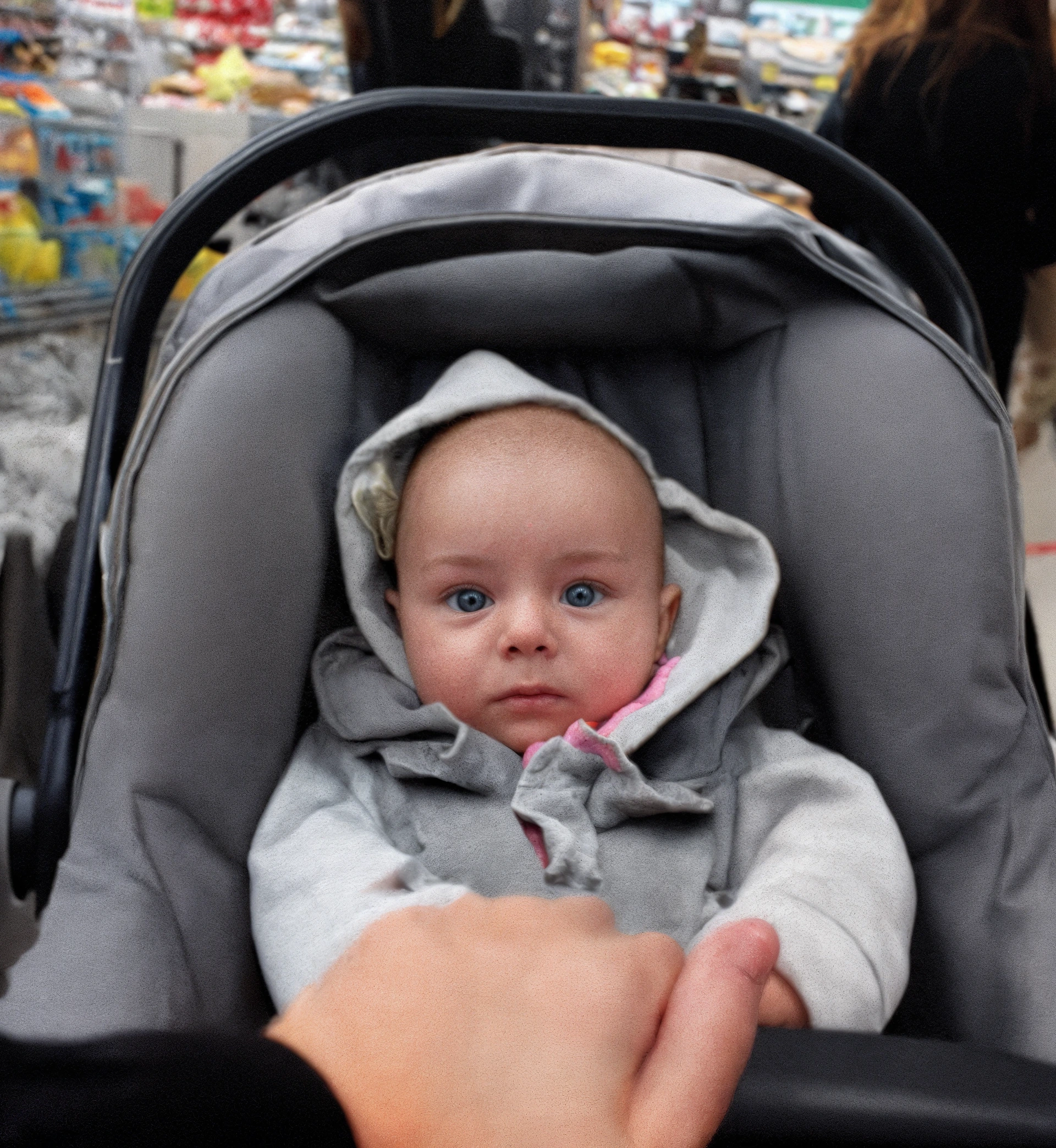
While Helen faces the challenge of raising her granddaughter on a tight budget, an embarrassing trip to the grocery store threatens to shatter her spirit. However, a single unexpected act of kindness opens the door to hope, healing, and a different kind of family she never anticipated.
I am Helen, aged 68. My life changed drastically six months ago when my son and daughter-in-law tragically lost their lives in a car accident. They had set out that morning for a brief stroll and never returned.
That afternoon, I transitioned from being a mother to a grandmother, albeit to my newborn granddaughter Grace, who was just a month old at the time.
At my age, I thought the toughest years of parenting were behind me. I envisioned peaceful afternoons in my garden, quiet evenings immersed in a book, and even the possibility of a cruise with friends if my savings allowed it.
Instead, I frequently found myself pacing at 2 AM with a crying infant in my arms, struggling to recall how to prepare formula while my hands shook.
The shock of this situation was overwhelming. Some nights, I would sit at the kitchen table with my head in my hands, whispering to myself in the silence.
“Can I truly manage this? Are there enough years left for me to provide this sweet child the life she deserves?”
The silence wasn’t an answer.
Occasionally, I’d voice my questions aloud.
“What if I fail you, Grace?” I murmured one night as she finally slept in her bassinet, her tiny chest rising and falling with shallow breaths. “What if I let you down, my love? What if I’m too old, too tired, or too slow?”
My words faded into the background hum of the refrigerator or the dishwasher, unanswered. Yet, merely saying them aloud in that room gave me a peculiar strength to continue.
To stretch my budget, I took on any odd job I could find: pet sitting for neighbors, sewing for the church bazaar, and tutoring children in English literature and reading.
Somehow, each dollar seemed to vanish into diapers, wipes, or formula. There were weeks when I skipped meals to ensure Grace had everything she needed, times when I’d boil only potatoes, convincing myself I wasn’t that hungry.
Then, as if by instinct, little Grace would reach her sticky hands towards me, intertwining her fingers with mine while staring at me with eyes that held the memory of her parents. At that moment, I remembered she had no one else. She needed me, and I could never abandon her.
Today, at seven months, she is curious, lively, and filled with laughter that brightens even the darkest days. She tugs at my earrings, caresses my cheeks, and giggles when I tickle her tummy.
Key Insight: Raising her is undoubtedly taxing and expensive, yet at the end of every month—even when I meticulously count each dollar and ration the food—I know one thing is true: she is worth every sacrifice.
It was the last week of the month when I entered the grocery store carrying Grace. Outside, the autumn air was crisp and biting, the kind that heralds winter, and I had precisely 50 dollars left until my next check arrived.
Pushing the cart down the aisles, I whispered to Grace:
“We will get what we need, sweetheart,” I reassured her. “Diapers, formula, and fruit for your puree. Then we’ll head back home, and you’ll have your bottle. Sound good, darling?”
She cooed softly, and for a fleeting moment, I allowed myself to believe everything would turn out alright.
Carefully, I placed each item into the cart, mentally calculating as I questioned every selection. I started with the essentials: formula, diapers, wipes, bread, milk, cereal, and apples.
I passed by the coffee aisle and paused for a moment, but then shook my head and moved on.
“You can live without it, Helen,” I told myself. Coffee was a luxury, and luxuries had no place in my budget. I hurried past the seafood section, forcing my eyes to avoid the fresh salmon.
“Your grandfather made the best lemon ginger salmon,” I told Grace. “He’d add coconut milk and bake it. It was divine.”
Grace looked at me with her big eyes.
At the checkout, the cashier—a young girl in bright lipstick with tired eyes—greeted me politely. She scanned the items as I bounced Grace on my hip, and for a moment, I dared to hope the total would be manageable.
“Alright, ma’am,” she said. “Your total is $74.32.”
My stomach dropped. I pulled out the 50-dollar bill from my wallet and began rummaging for coins at the bottom, my fingers shaky. Grace started squirming and fussing, her cries escalating as if she could sense my panic.
“Come on, ma’am,” said a man behind me, sighing loudly. “Some of us have places to be.”
“Honestly, if people can’t afford to have kids, why do they insist on having them?” muttered another woman.
My throat tightened, and I gripped Grace a little tighter, as if that could protect her.
“Shh, sweetheart,” I whispered to her as the coins slipped through my fingers. “Just a moment longer.”
“Are you kidding me?!” a younger man exclaimed a few people back. “Adding a few groceries isn’t that hard!”
Grace’s cries grew louder, echoing beneath the high ceilings of the store, making it feel as though every pair of eyes was burning a hole through me. My cheeks flushed, and my hands trembled so much I could barely collect more coins.
In that instant, I felt the walls of shame closing in around me.
“Please,” I said to the cashier, my voice trembling. “Let’s remove the cereal and the fruit. Just leave the formula and the diapers. I think we can do without the wipes too.”
The cashier rolled her eyes and let out an exasperated sigh as she began removing each item one by one, the sharp beep of the scanner ringing in my ears. Every sound felt like a judgment, as though the machine itself was announcing my failure to the line of strangers behind me.
“Really? Ma’am,” she said, her lips pressed tight in irritation. “Didn’t you check the prices before filling your cart? How much longer do you think you can waste our time?”
I opened my mouth to respond, but no sound came out. My throat felt tight, my cheeks burned, and I wanted to cry. Meanwhile, Grace continued to wail, her tiny fists pressed against my chest, as if she could feel every ounce of my shame.
“We’ve been here forever! This baby is screaming like crazy! Someone get her out of here. This is a grocery store, not a daycare!” shouted someone.
“If she can’t afford her shopping, maybe she shouldn’t be raising kids,” added another voice, sharp and bitter.
Tears pricked my eyes. My hands shook so much that I nearly dropped the receipt I was holding, the damp paper clenched in my palm. My heart raced, my vision blurred, and for a horrific moment, I thought I might faint right there in line.
“Please,” I pleaded again, my voice cracking as I tried to cradle Grace against my chest. “Just the baby’s items. Please. That’s all she needs.”
And then, out of nowhere, Grace stopped crying.
The sudden silence startled me; her sobs, which had filled the store for what felt like ages, ceased, and when I looked down at her tear-streaked face, my eyes followed the direction of her tiny finger.
She was pointing at someone behind me.
I turned around and saw a tall man standing there, perhaps in his thirties, with kind eyes that softened as they landed on Grace. Unlike the others, he wasn’t huffing or casting irritated looks.
His expression was calm, and a gentle smile adorned his face. He appeared almost protective over us.
“Please, ring up everything she has,” he said, stepping forward and speaking clearly. “I’ll pay.”
“Sir, you don’t have to…” the cashier blinked. “I don’t want this to come out of my paycheck.”
“I said to ring everything up,” he replied. “I’ll pay.”
A warmth surged in my cheeks. I shook my head, offering him my crumpled bill.
“No, no, sir, you don’t have to do this,” I stammered. “I just miscalculated. I thought that—”
“Here. You’ll need it. For you. And for her,” he said, gently shaking his head.
Grace’s little fingers reached towards him once more, and he smiled at her.
“She’s beautiful,” he said softly. “You’re doing an amazing job.”
Something inside me broke. Tears blurred my vision, softening the shelves around us.
“Thank you,” I murmured. “Thank you so much. She’s my granddaughter, and I’m doing my best. It’s just the two of us now.”
The line became quiet. The people who had complained moments before now shifted uncomfortably, some averting their eyes. The man passed his card through the reader.
“I’ve got this,” he said simply. Within seconds, the transaction was completed. The cashier, suddenly sweet, bagged my groceries without saying another word.
When he handed me the bags, my hands trembled. Without waiting for me to ask, he took the heavier ones, carrying them as if it were the most natural thing in the world.
Outside, I could breathe again.
“My name is Michael,” he said, walking alongside me toward the bus stop.
I managed to say, “I’m Helen.”
<p“She’s a precious little creature, Helen,” he said. “I have a daughter, Emily. She’s two years old. I’m raising her alone as well. My wife passed away from cancer last year. I recognized that look on your face.”
“What look?” I asked.
“The look of despair, guilt, anxiety… the list goes on,” he said. “I felt it too.”
“I’m so sorry,” I said, my chest tightening with empathy.
“I know what it means,” he nodded. “The sleepless nights, the fear of not having enough, and the constant wondering if you’re good enough. You’re not alone, Helen.”
Before I could respond, he slipped a small card into my hand.
“I run a support group,” he said. “For single parents, grandparents, widows… all of us. We help each other—with food, babysitting, and sometimes just listening. Come by sometime. You’ll always be welcome.”
I clutched that card as if it were made of gold. For months, I had carried the weight of grief, exhaustion, and the fear of failing Grace. That day, for the first time, I felt that weight lift just a little.
That Thursday, my heart racing, I placed Grace in her stroller and headed to the address on the card. The building was a small community hall. Laughter echoed from within—warm, genuine laughter that made me hesitate at the threshold.
“Helen! You came!” Michael exclaimed when he saw me, with Emily clinging to his leg.
Inside were half a dozen other people. Young moms managing their little ones, an older man raising his grandson, a recently widowed woman. They welcomed me not with pity, but with understanding.
Toys were scattered across the carpet where children played. Chairs were arranged in a circle, with adults sipping tea.
At first, I hesitated to share my story, my voice wavering, but no one judged me. On the contrary, they nodded, some reaching out a hand to hold mine. Grace cooed happily in someone’s arms as I breathed deeply for the first time in months.
Week after week, I returned to the group.
Grace got used to the familiar faces, the children, and the rhythm of the meetings. She started gurgling happily as I pushed her stroller into the hall, as if she recognized it as a place filled with laughter and warmth.
Michael always waved at me from across the room, with Emily sitting on his knees, and Grace’s arms flapped excitedly when she saw them.
Michael would check in with me between gatherings to see how I was doing—sometimes just to ask if Grace needed more formula or if I had managed to take a nap. Other times, he offered practical help—bringing groceries, leaving a meal ready, or fixing something in the house.
One Saturday, he replaced the leaking faucet in my kitchen. When I tried to apologize for asking him, he just laughed.
“Every now and then, all superheroes have to deal with plumbing, Helen.”
Our friendship deepened organically, as if we were following a rhythm that had been written long ago. Grace adored him, and Emily made Grace laugh by clapping her hands, causing me to smile.
Perhaps this was the family we didn’t know we needed, I thought.
Months have passed since that day in the grocery store, and life now feels different. Grace is nine months old, and her laughter fills the home. She now has people around her—a circle of friends who love her, play with her, and remind me that family isn’t just about blood.
I no longer feel like I carry this burden alone. The support group has become a second home. Shared meals, babysitting exchanges, and evenings of heart-to-heart conversations abound.
Each time I walk through that door, I feel lighter.
Michael calls Grace his “little ray of sunshine.” Watching her little fingers wrap around his hand has become one of the most comforting sights of my life. Sometimes, when I see them together, I think fate brought us to that grocery store for a reason.
That afternoon, humiliated in line at the checkout, I thought I had hit rock bottom. Instead, that was the moment everything changed. Because a man chose to step in.
Grace will never remember the cruel words of strangers or the tears on my face, but I will never forget how she reached out to Michael. Sometimes, I like to think it was her parents sending him to us.
And if that’s the case, then I know everything will be alright.
On a warm Saturday afternoon, a few weeks later, Michael invited us to the park with Emily. The air smelled of freshly cut grass and grilled hot dogs from a vendor near the gate. Michael let Emily walk ahead toward the playground, clutching a small paper bag.
“What’s in there?” I asked, shifting Grace onto my hip as she squirmed and squealed at the sight of the swings.
“You’ll see,” he said with a smile. “But I promise it’s something special for the girls.”
We sat on a bench near the fountain, watching Emily determinedly climb up the slide. Michael rummaged through the bag and pulled out two small cups of vanilla ice cream, each with a plastic spoon.
“Grace’s first ice cream,” he announced, handing me one with a smile.
I plunged the spoon into the ice cream and brought it up to Grace’s lips. She blinked at the cold, then puckered her lips and let out a happy squeal. Her little fists waved in the air, as if asking for more. I laughed so hard that tears filled my eyes.
“See?” Michael said, laughing. “She already loves the good things. That’s how it starts!”
“Look! She likes it! Granny, she likes it!” Emily laughed, pointing at Grace.
The word slipped out so naturally that I hardly noticed. I turned to Emily, who was bouncing in her seat, eagerly awaiting her ice cream.
“Granny?” I echoed softly.
“Yes,” she simply said.
My heart swelled to almost bursting. I looked at Michael—his eyes sparkled with the same emotion.
“You know it’s true,” he said softly. “You’ve been more than a friend to us, Helen. You’ve been… family.”
And in that moment, I understood the truth: Grace and I had found not just help, but a new kind of family. A family ready to make room for joy to return to our lives.