As the sun slowly rose over Los Angeles, Amy Whittaker awoke to the familiar rattling of the pipes in her student residence. The old building always seemed weary, as though it had witnessed too many eager students and countless ramen dinners to still pretend it was a home. She climbed out of bed, stepping over a heap of economics textbooks, and found Hannah standing by the window, already up with a steaming cup of coffee in hand.
“Today is the big exam,” Hannah declared. “I dreamt you forgot your calculator.” Amy chuckled. “I dreamt I graduated and never had to look at a calculator again.”
The two were complete opposites. Amy was the pragmatic accounting major, cautious, and the type who color-coded her receipts. In contrast, Hannah was the dreamy free spirit from Oregon, extroverted, beautiful without trying, drawing everyone’s gaze. They met during freshman orientation, two girls missing home who could barely afford campus coffee and shared a broken umbrella that was no match for the first Santa Ana wind. By the end of the week, they had become inseparable.
They navigated lazy ramen nights, second-hand furniture, breakups, and late-night confessions on the rooftop about their dreams of escaping student debt. “I’ll open a little shop,” Hannah said. “I’ll sell something authentic. Maybe handmade soaps.” “I’ll save other people’s money,” Amy replied with a smile. “Someone needs to manage your chaos.”
Years passed amid deadlines and takeout meals. Graduation arrived with caps, gowns, and promises shouted beneath the campus bells. Amy moved to San Francisco with a position at a mid-sized accounting firm; Hannah stayed in Portland, claiming she wanted to be closer to her family. At first, they texted every day. Then weekly. Eventually, it dwindled to once a month.
The first call for help came on a gray Tuesday. Amy was reconciling receipts when her phone buzzed. Hannah’s name appeared on the screen. “Amy,” Hannah said, her voice shaky. “My dad is sick. A heart problem. The roof collapsed during the storm; Mom’s house is soaked. I… I don’t know what to do.” Amy pictured Hannah’s little clapboard house she had seen in photos: peeling paint and wildflowers by the porch. “How much do you need?” she asked. “I hate to ask this.” Hannah’s voice broke. “Eight thousand. I swear I’ll pay you back in a year.”
Amy’s savings barely amounted to that. Hesitating, she opened her banking app. “Send me your account details.” “Are you serious?” “Of course,” Amy assured her. “That’s what friends are for.” There was a silence, a sob, then a whisper: “You’re the best thing that’s ever happened to me.” It felt good, almost heroic. Amy hit “Send,” unaware that this single transaction would echo through every aspect of her life.
The weeks turned into months. Initially, Hannah would check in with brief and grateful texts: _“Dad’s surgery went well. The roof is repaired. You saved us.”_ Then, silence ensued. Calls went unanswered. Instagram: ghosted. Facebook: deleted. Voicemail messages piled up until her inbox was full. It took Amy three months to admit it: her best friend had vanished.
At work, she forced smiles while processing expense reports. At night, she stared at the empty message threads, feeling foolish. _Maybe something happened to her_, she thought. _Maybe she lost her phone_. But deep down, she knew the truth. Betrayal didn’t come with a bang; it settled quietly, like dust.
Three years later, the dust had settled into a new life. Amy was twenty-eight, thriving, and engaged to Ryan Carter, a software engineer she had met at a mutual friend’s barbecue. Ryan was calm where Hannah had been wild, stable where Hannah had been electric. He loved order, predictability, morning runs, and black coffee with no sugar. Amy told herself that was what she needed now: tranquil waters, not turbulent tides.
They bought a small apartment in San Jose. He proposed in the kitchen, the ring hidden inside a fortune cookie. The message read: “Here’s your second chance forever.” Amy laughed, accepted, and never questioned what that “second” meant.
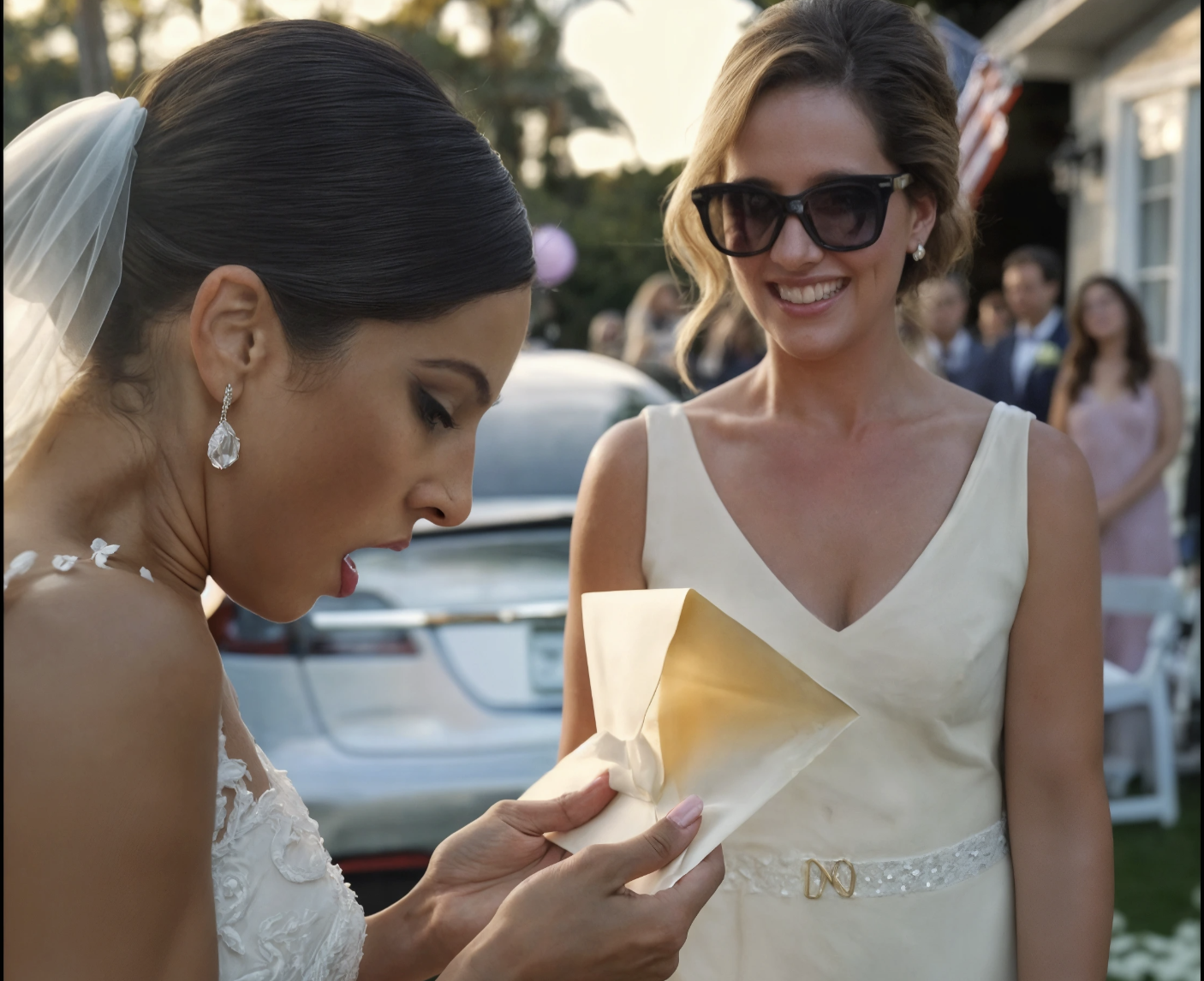
The wedding morning dawned bright and clear. A rented garden sparkled under white fairy lights. Her dress was simple and ivory silk that flowed like a sigh. Ryan looked impeccable in navy blue. Work friends filled the rows, clinking champagne glasses. The scent of roses and eucalyptus wafted through the air. Everything was perfect… until the Tesla arrived.
It glided up to the entrance, silent and gleaming—a car that belonged to no one from her past. Guests turned, murmuring. The door opened. A woman stepped out, tall and confident. She wore a cream Chanel dress and red Louboutin heels that crunched on the gravel like exclamation points. An air of French perfume trailed her. Dark sunglasses hid her eyes, but Amy recognized her instantly. Even after three years, she knew.
“Hannah,” she whispered. The name slipped out like a prayer she had forgotten to wish for. Conversations halted. Phones half-raised. Even the violinist paused mid-arpeggio. Hannah smiled—a polite little smile that didn’t reach her eyes—and made her way directly to the bride.
“Congratulations, Amy,” she said in a soft, confident voice, utterly foreign. “Today is the happiest day of your life.” She handed over a thick ivory envelope embossed with a golden edge, then turned as if to leave.
Amy stood frozen. “Wait…” But Hannah was already heading toward the Tesla. She slid into the driver’s seat, lowering her sunglasses just enough for Amy to catch a glimpse of recognition—and something colder—and then she drove away.
Guests murmured. Ryan approached, perplexed. “What was that all about?” “I… I don’t know,” Amy replied, her fingers trembling around the envelope. “An old friend.”
She tore it open. No cash. No card. Just a folded A4 sheet: a bank transfer receipt. Amount: $8,000. Sender: Ryan Carter. Recipient: Amy Whittaker. Note: “Repaying principal and interest. And you owe me an apology. – H.”
Amy’s knees buckled. Ryan’s name. Hannah’s initial. The world reeled.
Amid the confusion of applause and toasts, Amy’s smile turned porcelain. Every laugh sounded learned by heart. Every flash blinded her. When she was hugged, she felt hollow, like a mannequin programmed to celebrate.
Later that night, long after the last song and petals were swept away, she cornered Ryan in their bridal suite. He was loosening his tie, humming, still high from champagne and relief. “Why,” she whispered, handing him the paper, “is your name here?”
His face paled. “Amy, listen…” “Do you know her?” A long silence. Then, quietly: “Yes. Before I met you. We dated.”
A knot formed in Amy’s throat. “You dated Hannah?” “It was years ago,” he rushed to explain. “College. We broke up. I didn’t even know she was _your_ Hannah until you mentioned her, and by then, it was… too complicated.”
“Too complicated?” Amy’s voice broke. “You let me talk about her for years. You watched me cry over that money. You saw me search for her.” He swallowed hard. “I didn’t know she would contact me. She… wrote to me a few weeks ago. She wanted to make things right. I thought paying off the debt… would close the chapter.”
Amy stared at him, incredulity tightening like a vise inside her. “Did she use you to pay me back?” He remained silent. That silence spoke volumes.
Hours later, the party had ended. The house smelled of flowers and exhaustion. Amy, still in her wedding dress, sat alone with the bank statement in her lap. Outside, the sprinklers whispered over the empty lawn. Her phone buzzed. A message from an unknown number. _Hannah: You looked beautiful today. Tell Ryan to keep fulfilling his promises. – H_
Amy gasped for breath. She typed: _“Why did you do this?”_ But before she could send it, the message vanished—deleted, retracted, like a ghost reclaiming its words. She stared at the empty screen until dawn.
In another city, Hannah parked the Tesla at the base of a tower overlooking the Portland skyline. She removed her sunglasses and studied her reflection in the glass. Her eyes were red, not from tears but from sleepless nights. On her phone glowed a picture: Amy and Ryan’s wedding, taken from afar. She zoomed in on Amy’s smile. “One day you’ll understand,” she murmured. “We just settled the score.” She tucked her phone into her bag and headed to the elevator, her heels echoing like the ticking of a clock in a countdown neither of them yet knew.
The day after the wedding, the house smelled of stale champagne and wilted lilies. Amy woke up to a ray of sunlight seeping through the half-closed blinds, her veil still draped over the dresser as a relic from another life. Ryan was already gone. A note lay on the pillow. _Early meeting with investors. I’ll be back soon. Love you._
Investors. On a Sunday. She contemplated the stable, impassive handwriting and felt emptiness settle in her chest. The man who promised her honesty was beginning their marriage with absence. She made coffee, poured it into a mug that read _Mrs. Carter_, and tried not to think about the envelope resting in her bag. But it was there, pulsing like a second heart. The first sip was bitter.
By afternoon, she was on her computer, browsing through old photos. Dorm life at UCLA, birthdays, road trips: Hannah was everywhere. The last one was from their senior year: Hannah grinning in front of a dented Volkswagen with her arm around Amy’s shoulders, hair catching the sun. Below the photo, Hannah had commented: _“With you until death, Ames.”_ Amy whispered: “Death, apparently.”
She clicked Hannah’s name. Nothing. No profile, no trace. But Google never forgets. After an hour of searching, she found a thread: Hannah Lawrence – Portland Creative Agency – Co-founder. The agency’s website gleamed with a minimalist design, luxury brand clients, and a flawless team photo. Front and center: Hannah in a white suit, the smile of someone who possessed the sun. Amy’s pulse quickened. “How?” she murmured.
Three years earlier, she couldn’t afford a roof. Now she drove a Tesla and wore Chanel. Her phone buzzed. _Unknown: Are you awake? Still thinking about yesterday?_ Amy froze. _Amy: Who are you?_ _Unknown: You know._ She wrote: _“What do you want?”_ No response. Just the dots of “typing,” then silence. She tossed her phone onto the sofa, heart racing.
Across the state, Hannah Lawrence lounged in a leather chair overlooking the Portland skyline. She was alone, save for the hum of the espresso machine and the pulse of ambient music. Her assistant, Mara, poked her head in. “Conference call in ten minutes, Hannah.” “Push it back an hour.” Mara hesitated. “Everything okay?” “Perfect,” Hannah replied. “I’m closing an old case.” As the door closed, Hannah opened a drawer and pulled out a faded photo: two girls sitting on the floor of a dorm, sharing noodles, laughing at something out of frame. Her thumb traced Amy’s face. “I told you I’d pay you back,” she murmured. “With interest.”
Ryan arrived late that night. His tie was loosened, and his eyes were sunken. Amy sat in the living room, lights dimmed, the bank statement spread out on the coffee table. “Where were you?” she asked. He hesitated. “Work dinner.” “You don’t even eat at your work dinners.” He sighed, collapsing onto the couch. “Amy, I’m not doing this. Not tonight.” “Then when?” she shot back. “When you’ve finished transferring money to my old friend to buy her silence?”
“It wasn’t like that.” His tone hardened. “She called me. Said she wanted to repay you but couldn’t find you. She’d had my number for years.” “She had mine.” “She said you’d block her.” Amy scoffed, bitter. “And you believed her?” He rubbed his face. “I just wanted peace. For all of us.” “Peace?” Her voice trembled. “You were sleeping with her while she was robbing me, weren’t you?”
He snapped his head up. “No. That was long before we met.” “But you wanted her.” Silence. Ryan didn’t respond, and that silence said it all.
In the following days, the house felt colder. Amy haunted it like a ghost: working, organizing, pretending. Every night, she caught Ryan texting under the sheets. Every morning, he deleted the messages. She stopped asking questions. Instead, she wrote. At the office, she filled out spreadsheets; at night, she drafted questions. Pages full of crisp columns of doubts: _When did he see her again? Why the same amount in the transfer? Why on the wedding day?_
One night, pouring herself a glass of wine, she opened her laptop and wrote an email. _To: [email protected]_ _Subject: I want to see you._ _Body: You owe me more than money. Meet me where it all began. UCLA fountain. Friday at 6 p.m._ She hit send before she could lose her courage.
Friday arrived with a cool wind sweeping across the deserted campus. The fountain still shot thin arcs of water, sparkling in the sunset. Amy wore her old denim jacket, her heart racing. Every sound (footsteps, laughter, the wind in the palm trees) made her turn.
The Tesla parked silently. Hannah emerged, the very picture of self-control. Black trench coat, hair back, a thin scar over her eyebrow that Amy didn’t remember. “You came,” Amy said. “I always keep my appointments,” Hannah replied. “Unlike some others.” “Spare me the theatrics,” Amy snapped. “Why my husband?”
Hannah tilted her head. “Because he owed me too.” Amy blinked. “What are you talking about?” Hannah smirked. “Did Ryan explain to you why he left UCLA a semester early?” “No… he said he got an internship.” Hannah chuckled lightly. “An internship. How sweet.”
She leaned against the car, arms crossed. “We were together. He borrowed ten grand from me to invest in a _startup_ idea. Promised to pay me back after graduation. Instead, he disappeared. When I finally found him, he was with you.”
Amy felt her stomach churn. “So you paid him back with me?” “No,” Hannah replied calmly. “I settled my accounts. You lent me eight thousand; he owed me ten. I made sure both balances were square. It was just… poetic to do it on the big day.”
Amy’s voice broke. “You wanted to humiliate me.” “I wanted to teach you the cost of trust,” Hannah said. “You believe the world operates on kindness. I believe it runs on leverage. Guess who was right?”
For a long moment, neither spoke. Only the constant hissing of the fountain filled the air. Finally, Amy murmured, “You’ve changed.” Hannah’s smile faltered. “No. I just stopped being hungry.” She turned toward the car, then paused. “Tell him he can keep the car. It’s his, anyway.” And she walked away, leaving Amy in the echo of her disbelief.
That night, Amy confronted Ryan again. “She says you borrowed from her. Ten thousand.” Ryan froze. “That was years ago…” “Did you pay it back?” “I was planning to. The company went bankrupt before I…” “She says the Tesla is yours.” He swallowed. “Yes. I sold it last year when she reappeared in my life. I thought it was… closure.” Amy stared at him. “The ‘closure’ looks a lot like guilt.”
Ryan slumped his shoulders. “You don’t understand, Amy. She wasn’t who she is now back then. She was… fire. Made you feel alive. Then she became something else.” “And what did you become?” Amy asked. He didn’t respond.
The following week, Amy couldn’t stop thinking about Hannah’s words: _“I just stopped being hungry.”_ She wanted to reduce it to cruelty, yet it sounded like a confession. On a whim, she took a bus to Portland that weekend, telling Ryan she needed air. He didn’t protest.
The city was gray, enveloped in drizzle. Lawrence & Co. occupied a glass tower near the dock. The receptionist looked surprised when Amy mentioned her name. “She’s in a meeting,” the young woman said. “Do you want to wait?” “Yes,” Amy replied. “I won’t be leaving.”
Thirty minutes later, Hannah appeared, heels clicking, with impenetrable eyes. “You’re brave,” she said. “Or you’re crazy.” “Maybe both.” Hannah led her to a private room. “So, Amy? Do you want an apology? Another bank statement?” “I want the truth.” Hannah laughed. “That’s expensive.” “Try it.”
Hannah poured two glasses of whiskey and handed one to Amy. “I didn’t disappear for fun. After graduation, my father’s heart operation failed. He died two months later. Mom sold the house. I was drowning in debt. You were the only one who helped me, and I couldn’t even show my face when I couldn’t pay you back. I fled. Then Ryan found me.”
Amy’s fingers tightened around the glass. “He found you?” “He offered me a job: freelance design for his app. Said he wanted to help. Instead, he burned through the rest of my savings chasing investors. When everything fell apart, he disappeared. I lost everything.”
“And now you’re rich.” Hannah shrugged. “I rebuilt. Other investors. Another me.” Amy stared at her. “So yesterday wasn’t revenge?” Hannah’s smile tightened. “It was a balance. I wanted both of you to look yourselves in the mirror at the same time.”
For a moment, Amy almost felt pity for her. Then she remembered the envelope, the humiliation, how her marriage had turned to ashes. She stood up. “You wanted me to suffer.” “No,” Hannah said quietly. “I wanted you to wake up.”
Amy headed for the exit. “Be careful with him,” Hannah added. “Men like Ryan… they always think debts disappear when they stop counting.”
That night, Amy looked through Ryan’s laptop. Guilt made her hands tremble, but the screen unlocked easily. Emails (contracts, client lists) and a folder named _Lawrence Files_. Inside were PDFs of statements from a shared business account. Transfers between Ryan Carter LLC and Lawrence & Co., dating months before the wedding. Totals in the hundreds of thousands. She gasped for breath. At the end of one statement, a note: _Investment conversion to equity finalized, per agreement with H.L._ She continued scrolling. The last line read: _Transfer – Wedding gift – $8,000._ Her vision blurred. He wasn’t paying his debt. He was laundering his guilt through her.
The bedroom door swung open. Ryan stood there, pale, rain dripping from his coat. “What are you doing?” Amy lifted her gaze. “I’m counting.”
Ryan didn’t raise his voice. He never did. That was partly what scared Amy now: his calmness while everything around them slid into chaos. He moved closer, water dripping from his sleeves. “You searched my computer.” Amy kept her eyes on the screen. “You searched my life.” “Close that,” he ordered.
“No,” she whispered, reopening the last file. The spreadsheet glowed in the dark: transfers, dates, cryptic notes that meant nothing to her heart but everything to her clarity. “Hundreds of thousands, Ryan. You and Hannah. Months before the wedding.”
He rubbed his temples. “It’s not what you think.” “It looks like you were running a business together.” “She wanted to invest…” “She WAS your business,” Amy interrupted. “While I was picking centerpieces, you were signing contracts with the woman who ghosted with my savings.”
Ryan exhaled through his nose, slow and measured. “I was trying to fix things. You don’t understand what I owed her.” “You owed me honesty.”
Something broke in him then. He collapsed into the chair across from her, elbows on his knees, head down. For a moment, he looked young, scared, human. “I was twenty-two when I met Hannah,” he said softly. “She believed in my first _startup_ when no one else did. I used her savings, every dime, to keep it afloat. Then the market crashed. I promised myself I’d pay her back as soon as I got something stable, but… the company went under, I got it together, and the shame…” He paused, breathing heavily. “I ghosted her. I thought if I disappeared, the debt would too.”
“So she found you through me,” Amy said, her voice hollow. “You both used me to settle your accounts.” He looked up, red-eyed. “No. She wanted revenge. I wanted closure. You…” He hesitated. “You weren’t supposed to get hurt.” Amy laughed softly, a sound like broken glass. “People always say that right before they hurt someone.”
The following days unfolded in awkward choreography. Ryan worked late. Amy pretended to go to bed early. They floated around each other in the house like ghosts avoiding mirrors. But silence feeds questions, and questions crave answers. On Thursday, she couldn’t take it anymore. She called Hannah.
“Why are you doing this to him?” Amy launched in as soon as the line connected. On the other end, Hannah’s voice was cold, tired. “Doing what? Pushing him to tell the truth?” “You got your justice.” “Justice?” Hannah scoffed bitterly. “Do you think money or humiliation is justice? Do you think a transfer pays for a decade of being erased?”
A knot formed in Amy’s throat. “So you’re going to keep punishing him?” “No,” Hannah replied after a pause. “He’s already punishing himself. I just held up a mirror.” The line went dead.
That night, Ryan didn’t come home. His calls went straight to voicemail. At midnight, Amy paced the living room, half sick with rage, half sick with worry. When headlights finally swept through the curtains, she tensed. He entered, reeking of whiskey and rain.
<p“I saw her,” he said before she could speak. “I know,” Amy replied. “She wanted me to invest again. Something charitable… clean water, bearing her agency’s mark. Said it would make up for everything. But all I heard was another trap.”
Amy crossed her arms. “And what did you do?” He laughed without humor. “I left. Told her I was done paying.” She studied him. “Are you sure?” “I don’t know,” he admitted. “A part of me will always owe her for who I was. The rest just wants to forget she existed.”
She nodded slowly. “Forgetting doesn’t erase the consequences.” He looked at her then, really looked: the ring she hadn’t taken off, the weariness etched into her features. “Do you still love me?”
The question dropped like a stone in water. She wanted to say yes, but the truth trembled deeper, unsure. “I loved who I thought you were,” she said. “I still don’t know this version.” Ryan’s jaw tightened. “Then maybe you should discover it before deciding.”
The following morning, Amy drove to the trail by the creek, near the old orchard, the place she used to think before marriage turned her life into a spreadsheet of betrayals. She walked until the city noise faded. Only the wind, the leaves, and sometimes a bird remained. Her phone buzzed again. _Unknown: You’ll never understand if you don’t have the whole story._ _Amy: Then tell me._ _Unknown: Tonight. 8 p.m. Hotel St. Claire, room 904. Come alone._ She hesitated, staring at the message until the words blurred. Everything in her screamed it was a trap, but curiosity spoke louder than fear.
The lobby of the St. Claire was bathed in amber light and smooth jazz. Amy’s heels echoed on the marble as she entered the elevator. The ride up to the ninth floor felt endless. The doors opened: Hannah awaited her in the hallway, this time with her hair down, face makeup-free. “Thanks for coming,” Hannah said softly. “I wasn’t sure.” “I almost didn’t come.” “Then we’re even,” Hannah murmured as she opened the door.
The suite smelled of rain and expensive perfume. Folders lay scattered on the desk: contracts, statements, pictures. On the TV, the news ran silently: “THE INVESTIGATION INTO CARTER TECH EXPANDS.” Amy gasped. “What is this?”
Hannah poured wine into two glasses. “Proof that Ryan is still borrowing what he can’t repay.” Amy shook her head. “He wouldn’t…”. “He already did.” Hannah handed her a folder. Inside were documents… loans in Amy’s name, forged signatures, company records tying her tax ID to Carter Tech. Amy’s knees buckled. “No.”
“He used your line of credit,” Hannah said quietly. “Moved transfers through shell companies. I warned him. He didn’t listen.” Amy slumped in a chair. “Why show me this?” “Because I’m tired,” Hannah replied. “Tired of keeping score. You deserve to know before the headlines.”
Amy stared at her. “And what do you gain?” Hannah’s eyes glimmered. “Peace, perhaps. Or forgiveness. I still don’t know the price.”
A sharp knock interrupted: three crisp taps. Hannah froze. “He wasn’t supposed to…”. The door swung open. Ryan appeared, eyes wild, rain dripping from his coat. “So this is where you hide,” he said.
Amy jumped up. “Ryan, what are you doing?” “She called me,” he said, pointing at Hannah. “Claims she has proof I’m stealing. She’s trying to blackmail me before the signing.”
Hannah’s tone remained firm. “You forged her signature, Ryan. That’s not blackmail; it’s the truth.” He stepped forward. “You’ve always been dramatic.” Amy stepped in front. “Stop! Both of you!”
Ryan’s hand trembled—not with violence but desperation. “Amy, she’s manipulating you again.” Hannah raised the folder. “Then explain this.” A heartbeat of silence filled the air, only the rain against the windows.
Then Ryan exhaled. “I did.” Amy turned slowly. “What?” “I was drowning,” he said. “Investors pulled out. I needed a bridge, a few weeks. I forged documents in your name to buy time. I was going to fix it before you found out.”
Her vision narrowed. “My name. My credit. My life.” He reached out. “Amy, please.” She recoiled. “Don’t touch me.”
He glanced at Hannah. “Are you happy now? You’ve won.” Hannah’s eyes softened, strangely sad. “There’s nothing to win.” He scoffed. “You always wanted to play the hero after burning it all down.”
Amy murmured: “Out.” Neither moved. Then she screamed. “GET OUT!” The cry sliced the air. Ryan staggered toward the door and slammed it shut behind him. Silence crashed in, cold. Hannah remained stock-still, the glass trembling in her hand.
<p“I’m sorry,” she said. Amy wiped her tears. “Why? For ruining my marriage or for saving my life?” “Maybe for both.”
They sat on the floor until dawn, surrounded by paperwork and half-finished wine. For the first time since college, they spoke, not as enemies or victims, but as two women comparing scars. “I loved him,” Amy admitted. “I did too,” Hannah said. “Maybe different versions of him. The one I thought could change the world.”
Amy watched the gray light filter through the curtains. “And now what?” “You let him go,” Hannah responded softly. “File a report before he drags you down with him.” “And you?” “I disappear again,” she said. “For real this time.” Amy touched her arm. “You don’t have to.” Hannah smiled faintly. “Yes. Some debts never end; they just change names.”
By noon, Amy was back in San Jose, standing before the glass doors of the bank. She handed the manager the forged documents and her ID. “I need to file a fraud report,” she said. Her hands no longer trembled.
Outside, the sky was clearing. She deleted Ryan’s contact: a pulse, a heartbeat. Then she scrolled to another name, Hannah, and hesitated. Finally, she wrote a line: _“Thank you for the truth. I’ll pay the rest.”_ She sent it. There was no response. But as she crossed the street, she felt lighter, as if the great invisible ledger of her life had finally balanced.
It had been a year since that night. Time doesn’t erase everything — it never does — but it softens the edges, sanding the pain until it approaches tenderness. The small apartment in San Jose was behind her; she had moved to a bright flat above a flower shop in Sausalito, a place smelling of salt and peonies. She had traded balance sheets for her own accounting firm dedicated to local artists. The logo (a circle of linked hands) shone in pale gold on the storefront. Each morning, she opened her computer, poured herself a black coffee, and started over.
The trial of Ryan lasted three months. The charges (fraud, forgery, tax irregularities) filled business blogs for weeks. He pleaded guilty, negotiated, and served time in county jail. When the sentencing article came out, Amy read it once, folded the paper, and dropped it into the shredder. It wasn’t revenge. It was letting go.
No trace of Hannah remained. The Lawrence & Co. website was still up, but her bio had vanished, replaced by a gray box: “On extended leave.” Rumors filtered in sector newsletters (a sale to New York investors, a flight to Europe), but nothing definitive. Sometimes Amy wondered if Hannah had finally found peace… or just another mask.
Late afternoon, a package arrived at the office: a brown box, no return address. Inside was a single item wrapped in tissue paper: a leather-bound notebook. Her heart squeezed. The handwriting on the first page was unmistakable. _For Amy._ _Some debts aren’t paid with money._ _They’re paid by living well._ _— H._
Carefully stapled between the pages were receipts: donations to a cardiac foundation in Oregon in her father’s name, all marked as _Anonymous_. Amy smiled through sudden tears. “You did it, Hannah,” she whispered. “You really did.”
That evening, she walked down to the dock. The bay shimmered bronze under the setting sun; seagulls drifted lazily overhead. She sat on a bench with the notebook on her lap, finally allowing herself to remember it all; not the betrayal, but the girls they had once been. Two hungry dreamers with a borrowed umbrella, promising each other the world.
Her phone buzzed. An unknown number. She hesitated, then answered. “Are you still keeping the books?” a familiar voice asked. “Hannah,” Amy whispered. “Don’t sound so surprised.” “Where are you?” “Far enough to start anew.” A pause, the sound of wind on the line. “I heard about your firm. Congratulations.” “Thanks.”
Another silence. Then: “Do you hate me?” Amy stared at the horizon where the sky met the water. “Not anymore.” “Good,” Hannah said quietly. “Then we’re even.” “I don’t think we ever will be,” Amy murmured, “but maybe that’s okay.”
A laugh escaped the speaker. “Take care, Ames.” The call ended. Amy sat there for a long time, phone still pressed to her ear, Hannah’s voice echoing in a blend with the seagulls’ calls. Closure did not sound like victory. It sounded like acceptance.
Summer arrived early that year. Amy dove into her work, leading a weekly budgeting workshop at the community center, mentoring young women who reminded her of herself: eager, broke, full of hope. During one session, a student asked, “How do you know if you can trust people in business?” Amy smiled. “You don’t always know. But you can trust yourself to get back up when you mess up. That’s the real investment.” They wrote it on the board. It became the class motto. Later, she walked home along the waterfront, feeling lighter than she had in years.
Three months later, a letter arrived, postmarked from Paris. Inside was a photo of a storefront: “Atelier H.” Behind the glass, shelves of candles and handmade soaps glowed with warm light. On the back, in large handwriting, Hannah had written: _I told you I’d open a little shop. Consider this the interest on our friendship._
She pinned it above her desk. Each morning, the sun would hit it, making it glisten slightly, like a visible forgiveness.
Autumn arrived, crisp and golden. One Sunday, Amy drove north along Highway 1, the ribbon of asphalt wedged between the ocean and cliffs. She stopped at a viewpoint, wind tousling her hair, the Pacific stretching as far as her eyes could see. A man next to her was painting the landscape on a small canvas. He looked up, smiled, and offered her the brush. “Want to try?” She laughed. “I’m terrible at art.” “Then you’re free,” he replied. Dipping the brush in blue, she painted a streak of sky. The color ran beautifully, imperfectly. It hit her then that for the first time, her hands didn’t tremble.
That night, she wrote in the notebook Hannah had sent her. _Dear Hannah:_ _I thought you stole my trust. Now I know you forced me to see its worth. Perhaps that was your last gift. Wherever you are… thank you._ She closed the notebook, placing it on the shelf next to her wedding photo. She didn’t remove the image; she simply turned it slightly, so the reflection of the sea from her window touched its edge. The past deserved light too.
One year exactly after her wedding, Amy returned to the same garden. The place had changed names (the owners had turned it into a public park), but the stone arch still stood, covered in ivy. She brought a small bouquet of white daisies and laid it at the foot of the arch. A child chased a ball over the grass, laughing. Not far away, a couple exchanged vows under the same sky that had once seen her heart broken. She heard their promises, not with jealousy, but with quiet hope.
As she turned, she noticed a Tesla near the entrance; silver this time, not white. A woman sat inside, window down, sunglasses gleaming. She waved in a brief greeting. Amy smiled and waved back. The Tesla rolled away, vanishing down the winding entrance path. No words, no explanations; just a gesture, clear and final. Amy lingered until the sound of the engine faded, then she whispered into the wind, “Goodbye, Hannah.”
That night, she opened the window to the sea breeze. The city lights flickered below, steady, patient. She brewed tea, curled up on the sofa, and reflected on everything that had brought her to this point: the loan, the loss, the betrayal, the revelation. Life wasn’t a balance sheet after all. It was a rhythm of giving and receiving, of mistakes forging strength. Certain debts weren’t meant to be collected; they were meant to teach value. Amy closed her eyes, exhaling. For the first time, the silence didn’t feel empty. It felt deserved.
Epilogue
Two years later, an article appeared online: “Women Who Rebuilt Themselves.” Among the photos: Amy Whittaker, accountant and mentor. And below her photo, Hannah Lawrence, founder of Atelier H, Paris. Their stories were printed side by side. No mention of betrayal, money, or the marriage that had broken them; just two women described as “proof that even broken trust can blossom into purpose.”
Amy read the article once, smiled, and shut her laptop. Outside, the waves crashed against the dock in a steady rhythm, like a heart that refuses to stop. She murmured: “Balanced ledger.”
And somewhere across the ocean, in a shop that smelled of lavender and soap, another woman looked up, as if she had heard her.